IndiGo shares

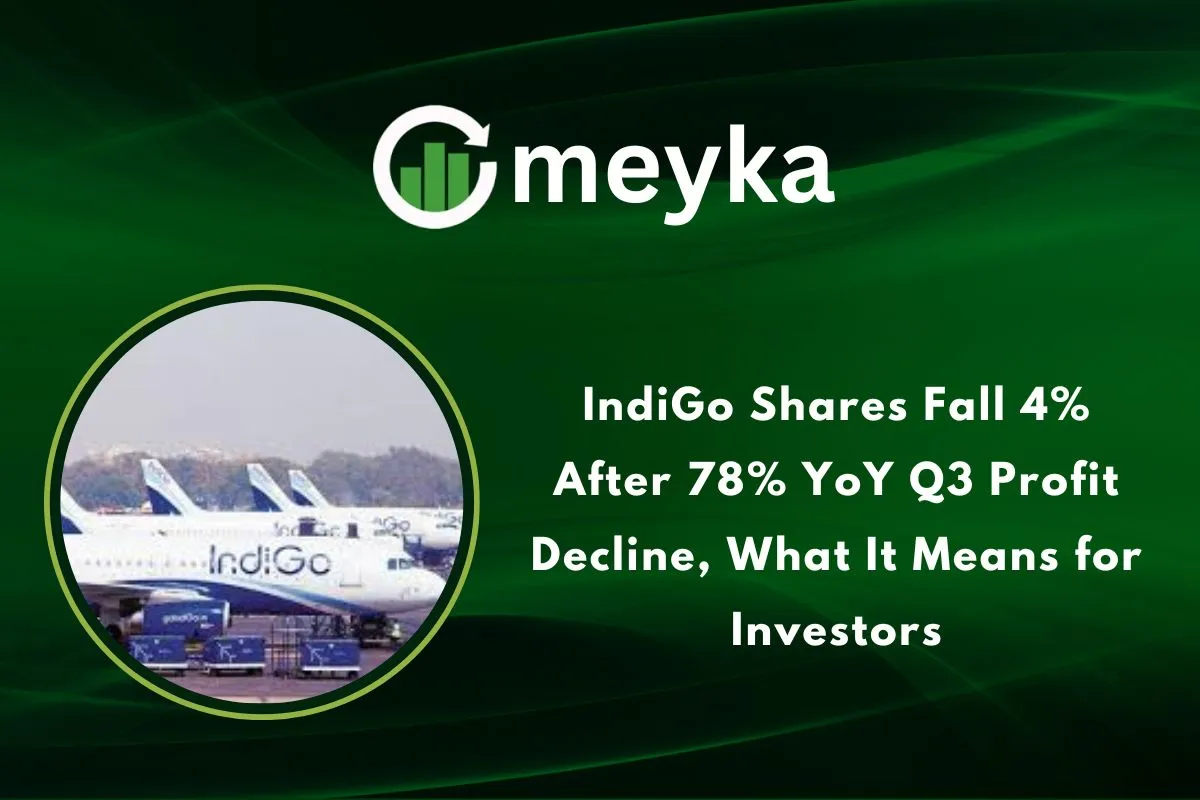
IndiGo Shares Fall 4% After 78% YoY Q3 Profit Decline, What It Means for Investors

The stock market doesn’t like surprises, especially big ones. That’s what we saw on January 23, 2026, when IndiGo shares slid about 4% after InterGlobe Aviation, the parent company of IndiGo, reported a 78% year-on-year drop in net profit for the third quarter (Q3). This sharp fall in earnings rattled investors and sparked fresh debate on whether the airline’s long-term growth story still holds for investors.

Q3 FY26 Results

  • Profit drop: IndiGo’s consolidated net profit fell 78% YoY to ~₹550 crore in Q3 FY26, compared with ₹2,449 crore last year, showing sharp earnings pressure.
  • Revenue growth: IndiGo’s revenue still rose ~6% YoY to ₹23,472 crore, indicating strong ticket sales despite disruptions.
  • EBITDAR stability: Operating cash-flow metric EBITDAR saw only a mild decline, suggesting core operations stayed resilient.
  • Underlying performance: Excluding one-off costs, IndiGo’s adjusted profit was much stronger, pointing to a healthier base business.
  • Simple takeaway: IndiGo sold more seats and earned more revenue, but unusual expenses dragged profits down.

Why Profit Dropped So Sharply

Flight Disruptions in December

  • Mass cancellations: IndiGo cancelled ~2,500 flights in early December 2025, disrupting travel for thousands of passengers.
  • DGCA action: India’s aviation regulator, DGCA, cut IndiGo’s winter schedule by 10% after repeated delays and cancellations.
  • Exceptional cost impact: These disruptions led to ₹577 crore in exceptional expenses, directly hurting quarterly profit.

New Labour Code Costs

  • Regulatory change: Implementation of India’s new labour codes forced IndiGo to recognise higher employee benefit liabilities.
  • One-time charge: The airline booked ₹969 crore in additional employee-related costs due to revised wage and benefit definitions.
  • Profit impact: This was a non-recurring cost, but it significantly reduced reported Q3 profit.

Currency Fluctuations

  • Forex pressure: Rupee depreciation increased IndiGo’s foreign currency expenses, adding stress to margins.

How the Market Responded, Why IndiGo Shares Fell

  • Share price reaction: IndiGo shares fell nearly 4% immediately after Q3 results were announced.
  • Earnings shock: Investors reacted negatively to the sharp profit miss, despite revenue growth.
  • Short-term caution: Traders turned defensive as earnings volatility raised near-term risk.
  • Technical selling: Falling prices triggered momentum-based selling and algorithmic trades.
  • Longer view: Despite the fall, IndiGo shares remain up on a one-year basis, showing long-term confidence.

Operational Performance, The Good Signs

  • Passenger demand: IndiGo recorded higher passenger traffic, confirming strong air travel demand in India.
  • Fleet expansion: The airline added net 23 aircraft during the quarter, supporting future capacity growth.
  • Load factor strength: Seat occupancy levels stayed healthy even amid operational challenges.
  • Network advantage: IndiGo maintained leadership across key domestic and international routes.

Valuation & Technical View for Investors

  • Valuation reset: After the dip, IndiGo shares are trading below recent highs, improving risk-reward balance.
  • Broker stance: Several brokerages maintained ‘Buy’ or ‘Add’ ratings, citing long-term growth potential.
  • Chart levels: Key support and resistance zones are now critical for short-term price movement.
  • Trading signal: Lower prices combined with strong demand can create tactical trading opportunities.

What Should Investors Do Now?

Long-Term Investors

  • Industry growth: India’s aviation market continues to expand rapidly.
  • Market leadership: IndiGo remains the country’s largest airline by market share.
  • Temporary setbacks: Most Q3 issues were one-time and not structural.
  • Investor approach: Long-term investors may consider holding or accumulating with patience.

Short-Term Traders

  • Price levels: Watch support zones closely after the post-earnings fall.
  • News flow: Monitor upcoming operational updates and cost trends.
  • Risk control: Volatility remains high, so disciplined stop-losses are important.

Broader Aviation Sector Outlook

  • Fuel sensitivity: Aviation margins remain vulnerable to fuel price swings.
  • Regulatory risk: Policy and labour reforms can create short-term earnings volatility.
  • Demand outlook: Domestic air travel demand in India remains structurally strong.
  • Sector view: Competition is intense, but long-term growth prospects remain intact.

Conclusion

IndiGo shares fell on the back of a large, unexpected profit decline. But once you strip out one-off costs, the airline’s underlying business still shows resilience with growing revenues and strong passenger demand. For long-term investors, this dip could present a buying opportunity if they believe in India’s aviation growth story. For short-term traders, volatility is likely until sentiment stabilizes.

Overall, stay informed about quarterly results and operational developments, because in airline stocks, earnings and execution matter a lot.

FAQS

Why did IndiGo shares fall after Q3 results?

IndiGo shares fell ~4% after the airline reported a 78% YoY drop in Q3 profit, mainly due to one-time costs and flight disruptions.

Did IndiGo’s revenue decline in Q3 FY26?

No. IndiGo’s revenue rose ~6% YoY to ₹23,472 crore, showing strong passenger demand despite operational issues.

Are the Q3 losses a long-term concern for IndiGo?

Not necessarily. Most of the profit decline came from one-off expenses, including labour code costs and disruption-related charges.

Is IndiGo stock good for long-term investors?

Many analysts remain positive due to IndiGo’s market leadership, fleet expansion, and strong demand outlook, despite short-term volatility.

Disclaimer:

The content shared by Meyka AI PTY LTD is solely for research and informational purposes. Meyka is not a financial advisory service, and the information provided should not be considered investment or trading advice.

Similar Posts

Leave a Reply

Your email address will not be published. Required fields are marked *