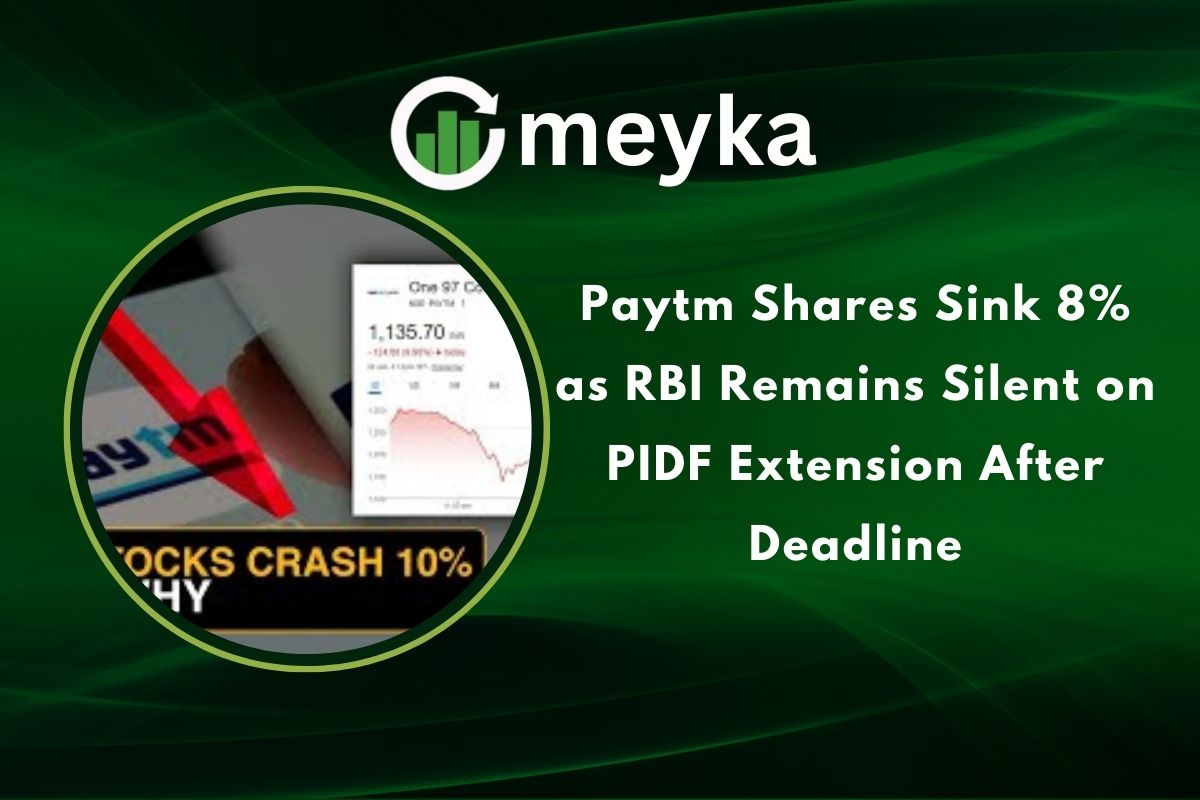
Paytm Shares Sink 8% as RBI Remains Silent on PIDF Extension After Deadline
Paytm Shares came under heavy selling pressure as investors reacted to regulatory uncertainty after the Reserve Bank of India stayed silent on the extension of the Payments Infrastructure Development Fund after the stated deadline. The stock slipped nearly 8 percent in intraday trade, reflecting nervousness around policy clarity, future growth visibility, and near term earnings impact.
This sharp fall once again shows how closely the Stock Market tracks regulatory signals, especially for fintech and digital payment companies. In this detailed report, we explain what PIDF is, why it matters so much to Paytm, what analysts are saying, and how investors should read this move calmly without panic.
What happened to Paytm Shares today
Paytm Shares dropped sharply during early trade, touching fresh short-term lows. Selling pressure intensified as the market digested the fact that the RBI did not announce any extension of the PIDF scheme even after the earlier deadline passed.
Why does this matter? Because PIDF directly supports the expansion of payment infrastructure like QR codes and POS machines, which is a core growth driver for Paytm’s merchant business.
The fall in the stock also came despite broader market stability, making it clear that this move was stock-specific rather than market-wide.
Paytm Shares and PIDF impact explained simply
What is PIDF, and why does it matter for Paytm Shares?
PIDF, or Payments Infrastructure Development Fund, was launched by the RBI to encourage the deployment of digital payment acceptance infrastructure in smaller towns and rural areas. Under this scheme, companies like Paytm receive support to install QR codes and POS machines at merchant locations.
For Paytm, this scheme plays a big role in scaling its offline merchant network at a lower cost. Over the past few years, the company has added millions of merchants using this support.
So what changed now? The PIDF scheme reached its deadline, and the RBI has not yet announced whether it will be extended or modified. This silence created uncertainty.
Investors started asking a simple question. If PIDF support slows down, will Paytm’s merchant additions slow down too? That concern hit sentiment immediately.
Why did Paytm Shares fall nearly 8 percent?
The fall in Paytm Shares was driven by a mix of fear, uncertainty, and cautious analyst commentary. Markets do not like regulatory silence, especially when deadlines pass without clarity.
Some traders also used this as an opportunity to book profits or cut exposure, as Paytm shares had seen volatile movement in recent weeks.
A report from CNBC TV18 highlighted that analysts are reassessing near term assumptions linked to merchant growth and margins. This was reflected in this update
The post pointed out how regulatory clarity remains the biggest overhang for fintech stocks.
Analyst view and Jefferies’ stance on Paytm Shares
Jefferies recently cut its price target on Paytm but retained a Buy rating. The brokerage flagged that the absence of clarity on PIDF extension could impact near term growth momentum.
However, Jefferies also noted that Paytm’s long-term story remains intact due to improving contribution margins, controlled costs, and focus on profitability.
According to Jefferies, if PIDF support is extended later or replaced with another policy measure, the negative impact could be temporary. But until then, volatility may continue.
This balanced view is important. It shows that while risks exist, the business is not broken.
Paytm Shares Key Market Reactions Today
• Paytm Shares fell nearly 8 percent in intraday trade as regulatory uncertainty weighed on sentiment
• Trading volumes spiked, indicating panic selling by short-term investors
• Brokerages turned cautious on near term growth assumptions
• Fintech stocks saw selective pressure, though the broader market remained stable
• Investors shifted focus to RBI communication, awaiting any official update
How the Stock Market is reading RBI silence
In the Stock Market, silence from a regulator often speaks louder than words. When deadlines pass without communication, markets assume delays or policy changes.
However, seasoned investors know that regulatory processes take time. Silence does not always mean rejection. It often means internal review.
This is why long-term investors are watching for official RBI communication rather than reacting only to price movement.
ET Now also shared an update highlighting this uncertainty
The post captured how traders are positioning cautiously until clarity emerges.
Is this fear or a real business risk for Paytm
This is the most important question investors are asking.
Is Paytm’s business model dependent only on PIDF?
The answer is no.
While PIDF helps reduce costs for merchant acquisition, Paytm has been steadily improving monetization through subscription fees, lending referrals, and value-added services.
Even without PIDF, merchant additions may slow but not stop. The real concern is margin impact, not survival.
That is why experts are calling this a sentiment-driven fall rather than a structural breakdown.
Financial health and operational progress of Paytm
Despite regulatory challenges, Paytm has shown improvement in operational metrics. Contribution margins have improved quarter after quarter. Cash burn has reduced significantly compared to earlier years.
The company continues to guide towards operating profitability in the coming quarters. This is a key reason why some brokerages are still positive on the stock.
This is also where AI Stock research tools are being used by institutions to track margin trends and unit economics more closely than before.
Paytm Shares What investors should watch next
• Any RBI update or clarification on PIDF extension or alternate support
• Merchant addition data in the next quarterly update
• Contribution margin trends, especially in payments and lending
• Stock price behavior near key support zones
• Institutional buying or selling patterns
Technical levels and short-term outlook
From a technical perspective, Paytm Shares have slipped below key short-term moving averages. Immediate support is seen near previous consolidation zones. If that level holds, some stability may return.
However, if selling continues, further downside cannot be ruled out in the short term.
This is where disciplined traders rely on trading tools to manage risk rather than guessing bottoms.
Social media and investor sentiment
Investor sentiment on social platforms is clearly mixed. Some see this fall as a buying opportunity, while others prefer to wait for clarity.
A retail investor perspective was shared here
The post reflects confusion among small investors, which is common during regulatory uncertainty phases.
Another ET Now update also pointed to caution
These posts show how sentiment is divided, not completely negative.
How long can this uncertainty last?
Regulatory clarity usually comes, but timing is uncertain. The RBI may choose to extend PIDF, modify it, or replace it with a different framework.
Markets may remain volatile until an official statement is released. This period tests investor patience more than business fundamentals.
Using AI stock analysis, many analysts are stress testing scenarios with and without PIDF support to assess fair value ranges.
Expert advice for retail investors
Experts suggest staying calm and avoiding emotional decisions. If you are a long-term investor, focus on business improvement and profitability trends.
Short-term traders should respect volatility and use strict stop losses.
This phase rewards patience, not haste.
Conclusion
Paytm’s shares falling 8 percent reflects regulatory uncertainty rather than a collapse in business fundamentals. The RBI’s silence on PIDF extension has created short-term fear, but the long-term digital payments story in India remains strong.
Investors should watch official communication, quarterly performance, and margin trends closely. Volatility may continue, but clarity will eventually return.
In the Stock Market, uncertainty creates noise, but fundamentals decide outcomes. Staying informed and calm is the best strategy during such phases.
FAQ’S
Panic selling is rarely a good idea. Decisions should be based on fundamentals and risk tolerance.
Not necessarily. It impacts near term growth assumptions, but the long-term digital payments story remains intact.
Yes, if regulatory clarity emerges or if management reassures investors with strong numbers.
Disclaimer
The content shared by Meyka AI PTY LTD is solely for research and informational purposes. Meyka is not a financial advisory service, and the information provided should not be considered investment or trading advice.