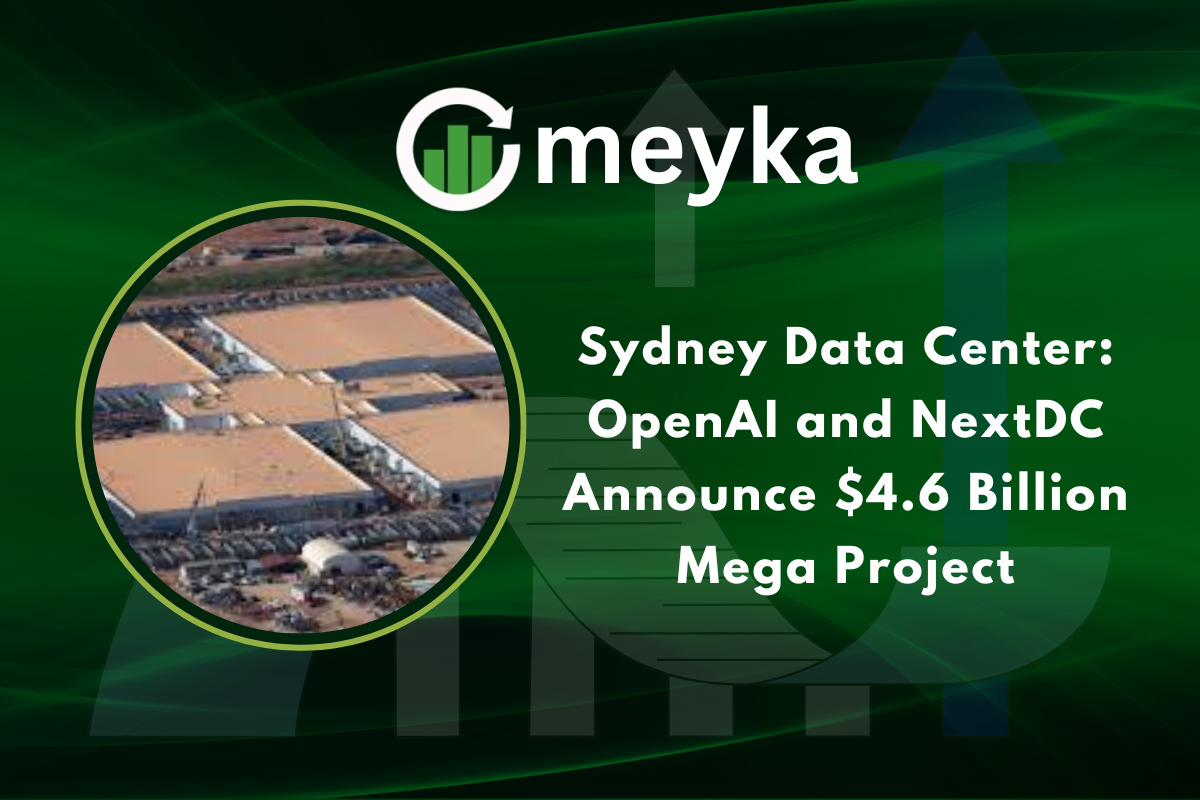
Sydney Data Center: OpenAI and NextDC Announce $4.6 Billion Mega Project
What is the Sydney Data Center by OpenAI and NextDC
OpenAI and NextDC have jointly announced plans to build a major AI-focused data centre in Sydney. The project is valued at A$7 billion (around US$4.6 billion) and aims to create a “hyperscale AI campus and GPU supercluster” near Eastern Creek, about 45 km west of Sydney’s city centre.
The facility, the new Sydney Data Center, is intended to serve as a backbone for high-performance AI workloads and to support enterprise clients and institutions using OpenAI’s models and cloud services across Asia-Pacific.
The announcement came with a surge in NextDC’s share price; the stock jumped as much as 10.9 percent on the Australian Securities Exchange, reflecting investor confidence in the deal.
Why the Sydney Data Center Matters: Strategic and Economic Importance
Meeting booming demand for AI infrastructure
Globally, tech firms are pouring billions into AI infrastructure, and OpenAI’s investment fits into this broader push for compute power and data centres.
Australia is positioning itself as an AI hub in the Asia-Pacific region. This data centre will provide local compute capability for AI, which strengthens sovereign infrastructure, reduces latency for users in the region, and ensures data residency.
For NextDC, this is a landmark project, with estimated capacity up to 550 megawatts, making it one of the largest data-centre investments in Australia’s history.
Economic growth and job creation
According to NextDC and Australian government estimates, the Sydney Data Center project is expected to create thousands of direct and indirect jobs, from construction to ongoing operations, maintenance, engineering, and support roles.
It could also accelerate AI adoption across industries, boost local AI-based business growth, and stimulate investments in related sectors like renewable energy, cloud services, and digital infrastructure.
Strengthening AI sovereignty and infrastructure resilience
Having a locally based, high-capacity data center gives Australia a strategic edge. As outlined in OpenAI’s “Australia Economic Blueprint”, sovereign AI infrastructure ensures that data and compute remain under Australian jurisdiction, providing compliance, security, and data sovereignty benefits.
This reduces reliance on foreign data-centre infrastructure and supports the country’s ambitions to lead AI development in the Indo-Pacific region.
Key Details: What We Know So Far
Location and capacity
The Sydney Data Center will be built at NextDC’s S7 site in Eastern Creek, land previously acquired by NextDC for about A$353 million.
The planned capacity is up to 550 megawatts, a scale that can support a large GPU supercluster and heavy AI workloads.
It is expected to serve OpenAI’s enterprise clients in Australia, such as major banks and services firms, offering data localisation, reduced latency, and secure compute for AI applications.
Partnership details and roadmap
The collaboration is based on a memorandum of understanding (MoU) between OpenAI and NextDC. Under this MoU, they will jointly plan, build, and operate the hyperscale campus.
NextDC has already increased its capital expenditure guidance for FY26 by A$400 million to scale capacity for this and related projects.
While the project is ambitious, it aligns with a broader trend among global tech firms to invest in AI data-centre infrastructure amid surging demand for compute power and storage.
What questions are people asking, and the answers
Why is OpenAI investing so much in Australia?
OpenAI sees Australia as a strategic location for AI expansion: stable governance, growing demand for AI services, and favourable policies. The “Australia Economic Blueprint” outlines how such infrastructure can add large economic value by 2030 through AI adoption and sovereign compute capability.
Local data residency and lower latency for Asia-Pacific customers make Sydney attractive. Also, building capacity closer to clients ensures better performance and compliance.
Could energy demand or environmental impact be a problem?
Yes, critics have raised concerns. A data centre of this size uses enormous power and cooling resources, and with demand for data centre electricity expected to rise in the years ahead, it could strain Australia’s energy grid.
Similarly, data centres consume lots of water for cooling. Analysts warn that the rapid growth of such facilities might stress water supplies if not managed sustainably.
OpenAI and NextDC say they are aware of these challenges; any long-term plan will likely involve energy efficiency, sustainable power sourcing, and advanced cooling systems.
What this means for Australia, the Tech Industry, and the AI Ecosystem
Turning Australia into an AI powerhouse
The Sydney Data Center could mark the beginning of Australia’s transformation into a regional centre for AI infrastructure. With sovereign data-centre capacity and global clients, the country could attract more investments and talent.
This infrastructure could help boost national productivity, drive adoption of AI across sectors like healthcare, finance, education, and small businesses, aligning with national AI goals.
Competitive boost for NextDC and data-centre operators
NextDC’s commitment to this mega-project may position it as a leading regional provider of cloud and AI infrastructure. It may also influence other data-centre operators to expand capacity, scale up GPU clusters, and offer specialised AI hosting services.
Global AI race intensifies
As OpenAI invests beyond the United States, it signals that global AI infrastructure is decentralizing. Nations that build strong computing capacity, regulatory frameworks, and data sovereignty will become hubs for future AI innovation.
Australia’s push may prompt other countries in the Asia-Pacific to accelerate data-centre and AI infrastructure development to remain competitive.
What Could Go Wrong: Risks and Challenges
- Energy infrastructure constraints: If grid upgrades and renewable energy capacity don’t keep pace, power demand may strain supply and increase costs.
- Environmental impact: Water consumption for cooling and heat dissipation could stress water supplies and local ecosystems if not managed.
- Regulation and compliance challenges: Data privacy, AI regulation, and compliance around the usage of data and compute could become complex, especially with international clients and sensitive AI workloads.
- High capital and operational costs: Such large-scale infrastructure requires large upfront investment, ongoing operational expense, and efficient scalability to be profitable.
What experts and stakeholders are saying
Some energy experts warn that Australia’s current power infrastructure may be inadequate to support a large centre drawing 550 megawatts, especially as data-centre demand is expected to rise further by 2030.
Environmental groups express concern over water usage for traditional cooling systems, urging the adoption of modern, efficient cooling or liquid-cooling tech to reduce water stress.
On the pro-investment side, government and industry leaders view the centre as a major step towards building sovereign AI infrastructure, creating local jobs, and anchoring Australia in the global AI economy.
What you, as a citizen or business, should watch
If you are a business in Australia or Asia-Pacific planning to use AI services, the Sydney Data Center could offer local, compliant, high-performance infrastructure, meaning faster responses, better privacy, and lower latency.
For investors, data-centre and cloud infrastructure providers may become attractive long-term bets as demand for AI compute and storage grows.
On the public policy side, keep an eye on how regulators, governments, and communities handle energy, water, environmental, and social impacts. The success of the project depends on sustainable expansion.
Final Thoughts
The Sydney Data Center by OpenAI and NextDC is more than just a new building. It is a bold bet on the future of AI, compute infrastructure, and Australia’s place in the global tech landscape.
If executed well, it could make Australia a regional hub for AI infrastructure, attract global business, create jobs, and support widespread AI adoption.
But the path ahead also has challenges: energy demand, environmental impact, cost, and regulatory responsibilities.
This project highlights a critical truth about the AI era: compute, data centres, and infrastructure matter as much as algorithms and models.
As this mega-centre builds up in Sydney, all eyes will be on the balance between growth, sustainability, and the promise of next-generation AI.
FAQ’S
The Sydney Data Center is a 4.6 billion dollar AI mega-project planned in Eastern Creek to build a hyperscale AI campus and GPU supercluster. It aims to power advanced AI workloads for businesses across Australia and the Asia Pacific.
OpenAI sees Australia as a strategic location with strong AI adoption potential, stable policies, and rising enterprise demand. Local infrastructure also improves latency, security, and data residency for regional clients.
The facility is planned to have up to 550 megawatts of capacity. This massive power requirement has raised concerns about energy supply and environmental impact.
The project will create thousands of jobs, boost AI innovation, support sovereign compute capability, and attract more global tech investment. It also helps position Australia as an AI hub in the Indo-Pacific.
Yes, experts warn about energy strain, water usage, high operational costs and environmental challenges. Sustainable power, cooling systems and strong regulations will be critical for long-term success.
Disclaimer
The content shared by Meyka AI PTY LTD is solely for research and informational purposes. Meyka is not a financial advisory service, and the information provided should not be considered investment or trading advice.