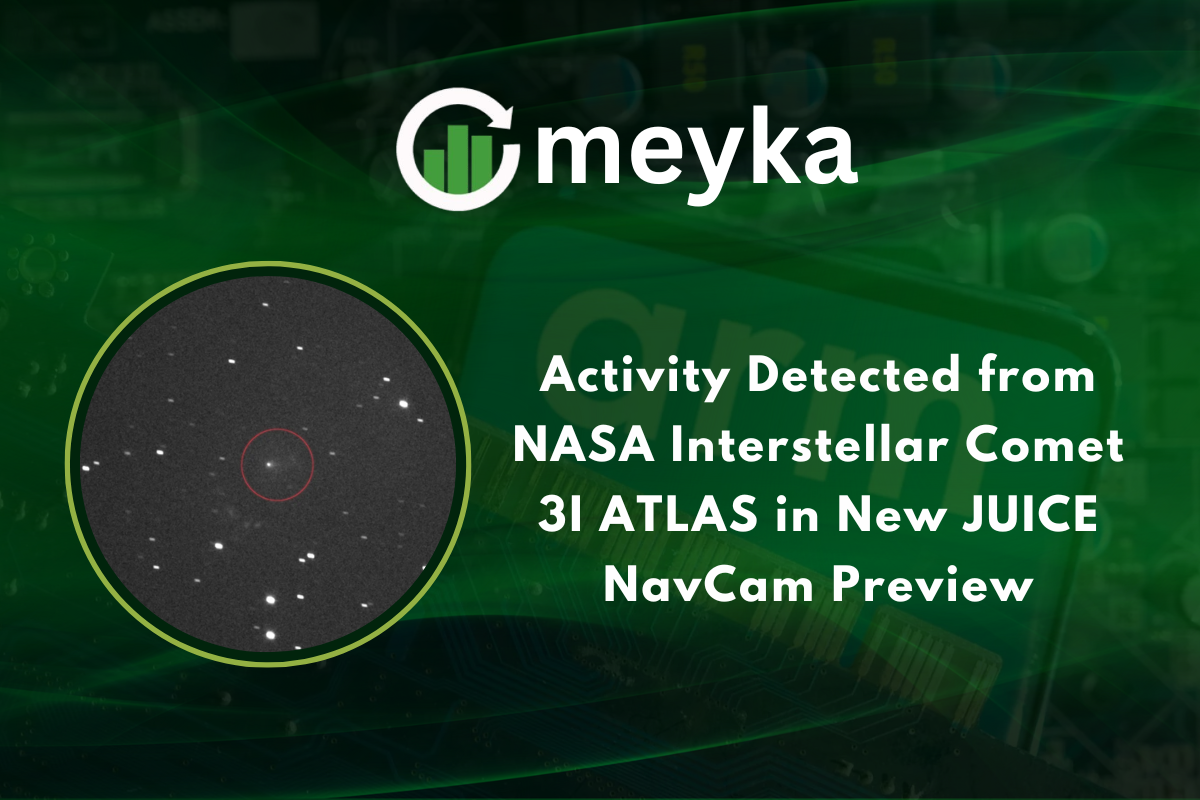
Activity Detected from NASA Interstellar Comet 3I ATLAS in New JUICE NavCam Preview
NASA Interstellar Comet 3I ATLAS Shines in New Images
NASA has confirmed that the interstellar comet 3I ATLAS is showing clear signs of activity in recent space imaging. Observations from the European Space Agency’s (ESA) JUICE spacecraft Navigation Camera (NavCam) reveal that this rare visitor from beyond our solar system is surrounded by glowing gas and dust as it sails through space.
The comet is only the third interstellar object ever identified, making every new image and data point hugely valuable for scientists studying distant worlds and early star systems.
What Is NASA Interstellar Comet 3I ATLAS
3I ATLAS is a mysterious object first spotted on July 1, 2025, by the NASA–backed ATLAS survey telescope in Chile. It travels on a hyperbolic trajectory, meaning it comes from outside our solar system and will eventually leave again once it passes by. The comet’s path and high speed confirm its interstellar origin.
Scientists have been watching 3I ATLAS closely because interstellar visitors are rare and provide a unique chance to study material formed around other stars.
Why Is It Important
This comet is scientifically important because it may carry clues about the building blocks of planets and materials from another star system. Studying its coma, the surrounding glowing cloud of gas and dust, helps researchers compare it to comets formed in our own solar system.
That comparison deepens our understanding of how stars and planets evolve across the galaxy.
Early Signs of Activity in JUICE NavCam Preview
What the NavCam Image Shows
The early NavCam preview image released by ESA shows 3I ATLAS surrounded by a bright halo of gas known as a coma. Around this comet, scientists noticed hints of two tail features:
- A plasma tail made of electrically charged gas particles
- A faint dust tail made of tiny solid particles is blown away from the comet’s nucleus
These features emerge as the comet warms up, traveling closer to the Sun, causing ices on its surface to sublimate and release gas and dust.
Although the NavCam wasn’t designed to take fine science images, it still offered a stunning preview of activity. ESA scientists downloaded just a small portion of one image to observe what might be happening at the comet. Their findings have built excitement for deeper analysis once the full data arrives.
What’s Happening Behind the Scenes
Scientists are still waiting for detailed scientific data from other instruments on the JUICE spacecraft. These instruments were active during the observation period and are expected to offer rich insights into the comet’s composition and structure later in February 2026.
How NASA and Space Telescopes Track 3I ATLAS
NASA has used a network of space observatories to study this interstellar visitor. These include:
- The Hubble Space Telescope which photographed the fuzzy envelope of gas and dust surrounding 3I ATLAS in July and again later as it brightened.
- The STEREO spacecraft tracked the comet’s movement at great speed across the solar system.
- Orbital instruments like SOHO and PUNCH detected faint brightening and parts of the comet’s tail.
- NASA’s Mars orbiters and rovers briefly captured images when the comet was near Mars in early October.
Each of these sources contributes to a growing collection of observations that map how this object changes over time.
What Are Scientists Looking For
Scientists want to understand how the comet’s composition compares to comets formed around our Sun. They also hope to see how far the activity (gas and dust release) extends and how the comet reacts to solar heating. By comparing images from different telescopes and missions, researchers can build a clear timeline of 3I ATLAS’s activity as it moves through the inner solar system.
Social Excitement and Public Interest
The interstellar nature of 3I ATLAS has captured the imagination of sky watchers and scientists alike. Enthusiasts have been posting and sharing images and updates as the comet brightens and becomes easier to spot through telescopes from Earth.
Social media shows growing excitement as December approaches, when the comet will be best placed for viewing in the pre-dawn sky.
Amateur astronomers are also sharing their own observations, showing how even small telescopes can detect this rare visitor. The blend of professional imaging and public sharing of comet videos and photos highlights why this event is a major milestone in space observation.
What This Means for Science
A Unique Chance to Compare Worlds
Studying the NASA interstellar comet 3I ATLAS helps scientists compare materials formed around other stars with those from our own solar system. This comparison could reveal differences or similarities in chemical composition, ice content, and dust structure.
Testing Comet Theories
Comet activity as measured by NavCam, Hubble, and other observatories helps researchers test models of how comets behave when heated and how they shed material. The rare data from an interstellar comet challenge and enrich current theories, especially about early planet formation in other star systems.
Broader Impacts for Astrobiology
While 3I ATLAS is confirmed as a natural comet, studying its chemical makeup might also offer clues about the distribution of organic molecules that are essential for life. While speculative claims about artificial origins exist, mainstream scientists emphasize natural explanations based on outgassing and ice sublimation.
Conclusion
The NASA interstellar comet 3I ATLAS continues to dazzle scientists and sky watchers alike. New JUICE NavCam preview images provide an early look at the comet’s growing cometary activity, showing glowing gas and dust and hinting at both plasma and dust tails.
These findings, combined with a broader array of NASA and ESA observations, help build a detailed picture of how this rare visitor behaves as it moves through our solar system.
FAQ’S
It is the third confirmed interstellar object ever observed passing through our solar system, moving too fast and on a path that means it has not been bound to the Sun.
No, it will remain far away, about 170 million miles (270 million km) at its closest approach on December 19, 2025.
As the comet heats up from the Sun’s warmth, ices turn directly to gas, releasing dust and forming the observable coma and tails.
A coma is the glowing cloud of gas and dust around the icy nucleus of a comet, visible when it gets heated by the Sun.
More detailed data from JUICE’s scientific instruments will arrive in early 2026, providing deeper insight into the comet’s makeup.
Disclaimer
The content shared by Meyka AI PTY LTD is solely for research and informational purposes. Meyka is not a financial advisory service, and the information provided should not be considered investment or trading advice.