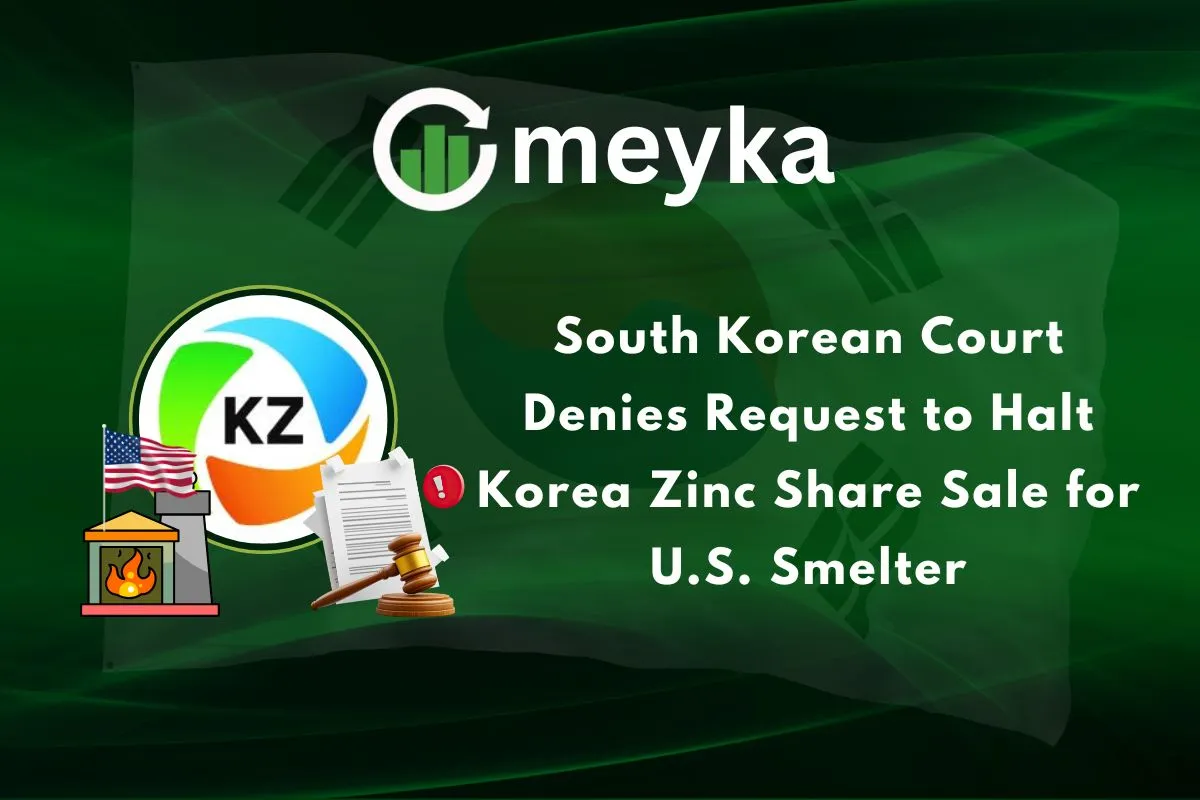
South Korean Court Denies Request to Halt Korea Zinc Share Sale for U.S. Smelter
On December 24, 2025, a South Korean court made a big decision that affects one of the country’s largest metal companies. The court denied a request to stop the Korea Zinc share sale plan that will help fund a major new smelter project in the United States.
Two major shareholders, MBK Partners and YoungPoong, had asked the court to block the share issuance. They said it could lower the value of existing shares and was done unfairly. But the Seoul Central District Court rejected their request, letting the company move forward.
The share sale is tied to a $7.4 billion critical minerals smelter in Tennessee. This new facility aims to boost the U.S. supply of key materials used in chips, electronics, and defense products while cutting reliance on foreign sources.
The court’s decision clears a major legal hurdle. It signals that Korea Zinc can continue with the deal that could reshape its future and affect markets far beyond South Korea.
Korea Zinc Case Background: Who’s Who and What’s at Stake
Korea Zinc is one of the world’s top metal refiners, known especially for zinc and other non-ferrous metals. It has also been moving into critical minerals like antimony and germanium, which are key for advanced electronics and defense products.
Two big shareholders, MBK Partners and Young Poong Corp., together hold roughly 46 % of Korea Zinc’s stock. They have been at odds with company management for months over control and strategy.
The company’s chairman, Choi Yun-beom, has been pushing a bold plan to build a $7.4 billion smelter facility in Tennessee, U.S., in partnership with the U.S. government. This project is meant to help secure a steady supply of critical minerals and reduce reliance on China.
To fund this, Korea Zinc plans to issue new shares to a U.S.-backed joint venture, which would own about 10 % of the company after the deal. The result has stirred a governance dispute, shaking investor confidence and raising questions about shareholder rights.
The Court Case, Legal Challenge, and Court Ruling
In mid-December 2025, MBK Partners and Young Poong filed a legal request to stop Korea Zinc’s planned share issuance. They argued that the new shares would dilute the value of existing holdings.
Their core claim was that issuing shares to outside parties could weaken their influence and unfairly benefit management at shareholders’ expense. They asked the Seoul Central District Court for an injunction to block the move. On December 24, 2025, the court rejected this injunction request. The judge ruled that the share issuance could go ahead as planned and that it served legitimate business purposes.
The ruling means the third-party share issuance, a key part of financing the U.S. smelter project, remains on track. Korea Zinc had scheduled the share payment for December 26, 2025. The court’s decision removed a major legal hurdle for the project. It supported the idea that the financing plan is a strategic step rather than a tactic to manipulate control.
Despite their legal loss, MBK and Young Poong said they still support the smelter idea in broad terms, even while maintaining concerns about fairness and shareholder value.
Strategic Context: U.S. Smelter Investment Plan
Korea Zinc’s smelter project in Tennessee, U.S., is designed to boost America’s capacity to refine critical minerals. These materials are vital for semiconductors, defense systems, and high-tech industries.
The facility represents a $7.4 billion investment approved by Korea Zinc’s board on December 15, 2025. A joint venture called Crucible JV, backed by the U.S. government and private American investors, will receive newly issued shares worth about 2.85 trillion won (≈$1.9 billion).
Once completed, Crucible JV will hold roughly 10 % of Korea Zinc. This ownership stake gives the U.S. side a role in the company’s future, while the facility itself aims to strengthen supply chains that have long depended on China.
The project ties into broader U.S. goals to diversify critical mineral sources. The U.S. government has pushed hard for domestic processing capacity to support electronics, electric vehicles, and defense needs. This investment also reflects Korea Zinc’s effort to secure a foothold in the world’s largest critical minerals market, giving it early access to fast-growing demand and strategic importance.
Market and Shareholder Impact
After the court ruling, Korea Zinc’s share price jumped, showing investor approval for the company’s strategic move. In contrast, shares of Young Poong fell sharply, reflecting uncertainty among dissenting shareholders.

Market watchers saw the decision as a win for the company’s leadership. It reduces the risk that the smelter deal will be delayed or blocked. However, the controversy highlights ongoing corporate governance tensions. MBK and Young Poong fear the new share issuance could weaken their influence and shift control within Korea Zinc.
Governance analysts say that issuing shares to a U.S.-backed investor might bolster Chairman Choi’s position in the long-running dispute with MBK and Young Poong. This dynamic adds another layer to the business story beyond the smelter itself.
For current and future investors, the case underscores the risks tied to strategic capital moves amid shareholder conflict. The outcome now points to a period of close watching and possible long-term effects on Korea Zinc’s share structure and market value.
Broader Implications: Corporate Strategy Meets National Policy
This court decision shows how corporate decisions can intersect with national policy goals. Korea Zinc is not just raising money. It is also helping fulfill a strategic need for secure mineral supplies in the U.S. and allied markets.
The case may set a precedent for how companies approach large cross-border investments that involve government partners. Stakeholders in other firms might watch closely to see how shareholder rights are weighed against strategic investment needs.
It also highlights tensions in global capital markets where national interests, shareholder value, and geopolitical strategy all collide. Firms aiming for similar projects may face legal and governance battles, especially when substantial changes in ownership structure are involved.
For South Korea and the U.S., the outcome supports deeper economic cooperation. The project could strengthen ties between the two countries in critical industries.
Conclusion: What’s Next?
The court’s decision on December 24, 2025, cleared a major legal block for Korea Zinc’s share sale tied to its U.S. smelter project.
Investors and analysts will now watch how the share issuance affects Korea Zinc’s governance and financial health. The progress of the Tennessee smelter and its strategic impacts on supply chains and global markets will unfold in the months ahead. The ruling may shape future deals where corporate strategy and public policy goals meet.
Frequently Asked Questions (FAQs)
The share sale may dilute ownership, but it helps fund long-term growth through a U.S. smelter project focused on critical minerals and future industrial demand.
Korea Zinc is investing in the U.S. to strengthen critical mineral supply chains, reduce reliance on China, and meet rising demand from technology, energy, and defense industries.
Disclaimer
The content shared by Meyka AI PTY LTD is solely for research and informational purposes. Meyka is not a financial advisory service, and the information provided should not be considered investment or trading advice.