US Stock Market Outlook: Dow, S&P 500, Nasdaq Futures Weaken After Strong Start to 2026
The U.S. stock market began 2026 on a strong note. Major indexes like the Dow, S&P 500, and Nasdaq pushed higher in the first trading days of the year. Investors were hopeful that good earnings and lower interest rates would support more gains.
But by January 7, 2026, that optimism started to fade. Futures tied to the Dow, S&P 500, and Nasdaq all weakened. Traders grew cautious after mixed economic news. Some data showed slower job growth. Other reports hinted that rate cuts by the Federal Reserve may not come as soon as hoped.
This shift surprised many observers. The early rally had lifted market sentiment. Yet now, uncertainty is rising. Traders are asking if the big gains in early 2026 can last. Let’s explore why futures weakened and what it could mean for investors this year.
US Stock Market: Record Highs & Early 2026 Strength
Wall Street began 2026 with strong gains across major indexes. The Dow Jones Industrial Average, S&P 500, and Nasdaq Composite all hit record highs early in the year as investors took in positive momentum from 2025. On January 6, 2026, the Dow climbed about 1.1%, while the S&P 500 rose roughly 0.8% and the Nasdaq 100 gained about 1.1%, lifting sentiment after expectations of future rate cuts by the Federal Reserve supported equity valuations.
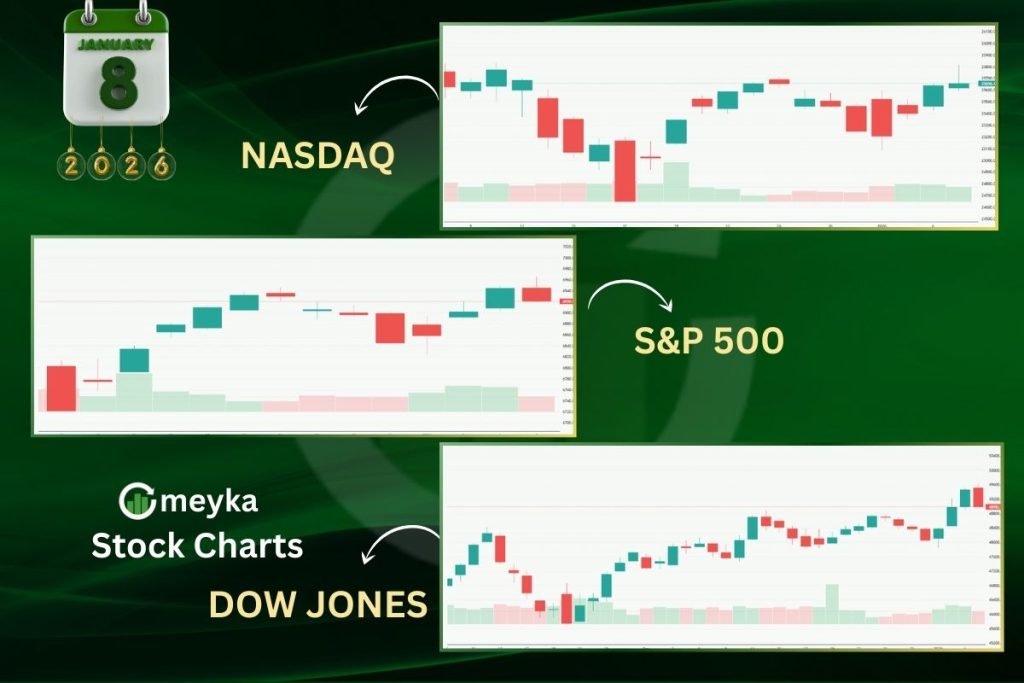
Semiconductors and healthcare stocks led the advance, while crude oil and energy sectors showed mixed movement. These gains reflected strong earnings growth and a continued belief that lower borrowing costs would help corporate profits in 2026. Yet even in this early surge, market participants remained attentive to global events and economic data that could shift sentiment.
Market optimism was partly driven by artificial intelligence spending growth and resilient labor market data. Investors hoped that continuing technology demand and rising profit margins would uphold broader gains. Yet this early strength also set the stage for a more cautious mood as details around economic reports and policy expectations came into focus.
The Pullback: Key Drivers Behind Weaker Futures of the US Stock Market
Macro Data & Interest Rate Expectations
By January 7, 2026, U.S. stock futures showed signs of slowing after the early rally. Futures tied to the S&P 500 and Dow Jones slipped modestly, while Nasdaq futures also edged lower. This followed a mixed session in which both the Dow and S&P hit intraday highs but closed lower, pointing to some profit-taking after extended gains.
Traders paid close attention to economic indicators that could affect the future path of Federal Reserve policy. As some reports suggested a slightly weaker hiring trend, investors grew less confident that rate cuts would occur as soon or as strongly as they hoped. This shift in Fed expectations reduced risk appetite in futures trading and pressured markets slightly lower.
Interest rate expectations remain central to market direction. Futures markets are pricing in more modest rate cuts than earlier forecasted, and this has tempered some of the early enthusiasm for equities. When markets suspect fewer rate cuts, valuations, especially for growth stocks and tech companies, can contract quickly.
US Market Sector Rotation & Mixed Internals
While the overall trend still showed gains year-to-date, some sectors reacted differently to the changing outlook. For example, homebuilder stocks dropped after political comments about limits on large institutional buyers of single-family homes. This reflects how market breadth can diverge during shifts in policy sentiment, with certain industries feeling more pressure than others. Small-cap stocks like those in the Russell 2000 index also fell slightly, pointing to a cautious sentiment toward companies seen as more sensitive to economic conditions.
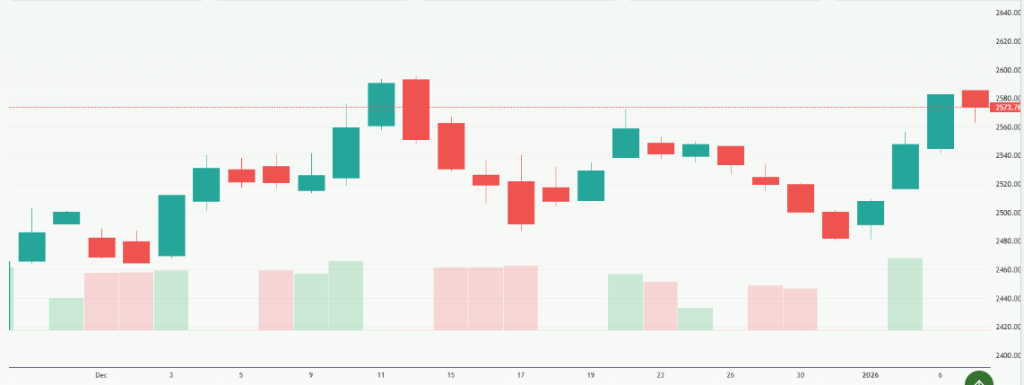
Index performance on January 7, 2026, showed that the S&P 500 declined 0.3%, while the Dow slipped 0.9%, even as the Nasdaq edged up 0.2%. This mixed internal action suggests investors favored some tech exposure but rotated away from broader cyclical assets as uncertainty rose.
Political & Policy Headwinds
Political developments added another layer of pressure. Comments from policymakers about housing market rules contributed to selling pressure in specific segments. These announcements can shift investor behavior quickly, especially when tied to regulatory or fiscal changes. Though markets have historically risen through policy noise, at times they pause to reassess expected corporate profitability when uncertainty spikes.
Investors are also watching geopolitical developments and fiscal policy decisions that could affect corporate earnings and economic growth. When policy risks increase, markets often take a defensive posture, which can dampen futures performance even after strong starts.
What Analysts are Forecasting in 2026 for the US Stock Market?
Analyst forecasts for 2026 remain mixed but generally positive over the long term. Many major financial institutions expect the S&P 500 to continue rising through the year, supported by solid earnings growth and technological expansion.
Some Wall Street strategists have predicted double-digit gains for the broad market in 2026, driven by long-term themes like artificial intelligence and productivity gains. These forecasts suggest that while short-term volatility may rise, the overall trend could remain upward if earnings support valuations.
At the same time, market valuation concerns have risen. Some analysts point out that U.S. stock valuations remain high relative to historical averages and many global peers. Elevated price-to-earnings ratios can make stocks vulnerable to corrections if earnings fail to meet expectations or if policy tightening returns. These valuation pressures are part of the reason why markets have paused after early 2026 gains.
In broader forecasts, some institutions also highlight how global markets like Asia or emerging markets could outperform if U.S. stocks cool. Investors are watching labor market data, inflation trends, and central bank actions as key signals that will dictate how bullish or bearish the year becomes.
Technical & Sentiment Indicators Suggest Caution
Technical indicators and market sentiment suggest that caution is warranted in the near term. Volatility measures like the VIX have ticked higher alongside the retreat in futures, which often means traders are adding protection or reducing risk. In this environment, even small moves lower can signal increased risk aversion.
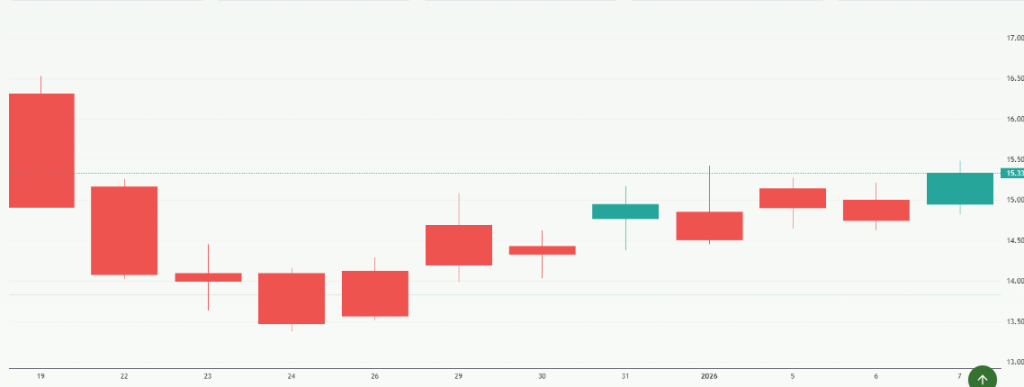
Some sector rotation also shows that traders are not uniformly optimistic. While tech stocks may still show resilience on strong earnings narratives, other areas like small-caps or cyclical industries are not attracting the same investor interest. This kind of divergence can signal that confidence in broad market strength is not yet fully stable.
How Investors Should Position Themselves in the US Market?
Given the mix of strong early 2026 performance and emerging caution, investors might benefit from a balanced approach. Diversification across stocks, sectors, and asset classes can help reduce risk if volatility rises. Watching economic data releases such as employment reports and inflation trends can provide clear cues about the direction of interest rates and overall market health.
Investors may also consider managing exposure to high-valuation growth names while looking for value opportunities in sectors showing resilience or defensive characteristics. Focusing on fundamentals rather than short-term headlines may help navigate uncertain periods.
Longer-term investors may find opportunities in solid, profitable companies with resilient earnings outlooks, while traders might watch technical levels and sentiment shifts closely to time entry and exit points as market conditions evolve.
Final Words
The U.S. stock market’s early strength in 2026 reflected a hopeful start to the year. But recent data and market actions show that investors are becoming more cautious. Macroeconomic reports, interest rate expectations, sector rotation, and policy developments all contribute to this shift.
Futures tied to the Dow, S&P 500, and Nasdaq have weakened after early gains, reflecting a more complex and uncertain outlook. By monitoring economic signals and maintaining a balanced strategy, investors may navigate the rest of 2026 with better clarity and resilience.
Frequently Asked Questions (FAQs)
In January 2026, U.S. stock futures weakened due to profit taking, mixed economic data, and uncertainty over the timing of Federal Reserve interest rate cuts.
Most analysts do not expect a crash in 2026. They forecast higher volatility as stock valuations remain high and economic growth signals stay mixed.
Investing in 2026 depends on risk tolerance. Long-term trends remain positive, but short-term pullbacks may occur during periods of market volatility.
Disclaimer
The content shared by Meyka AI PTY LTD is solely for research and informational purposes. Meyka is not a financial advisory service, and the information provided should not be considered investment or trading advice.