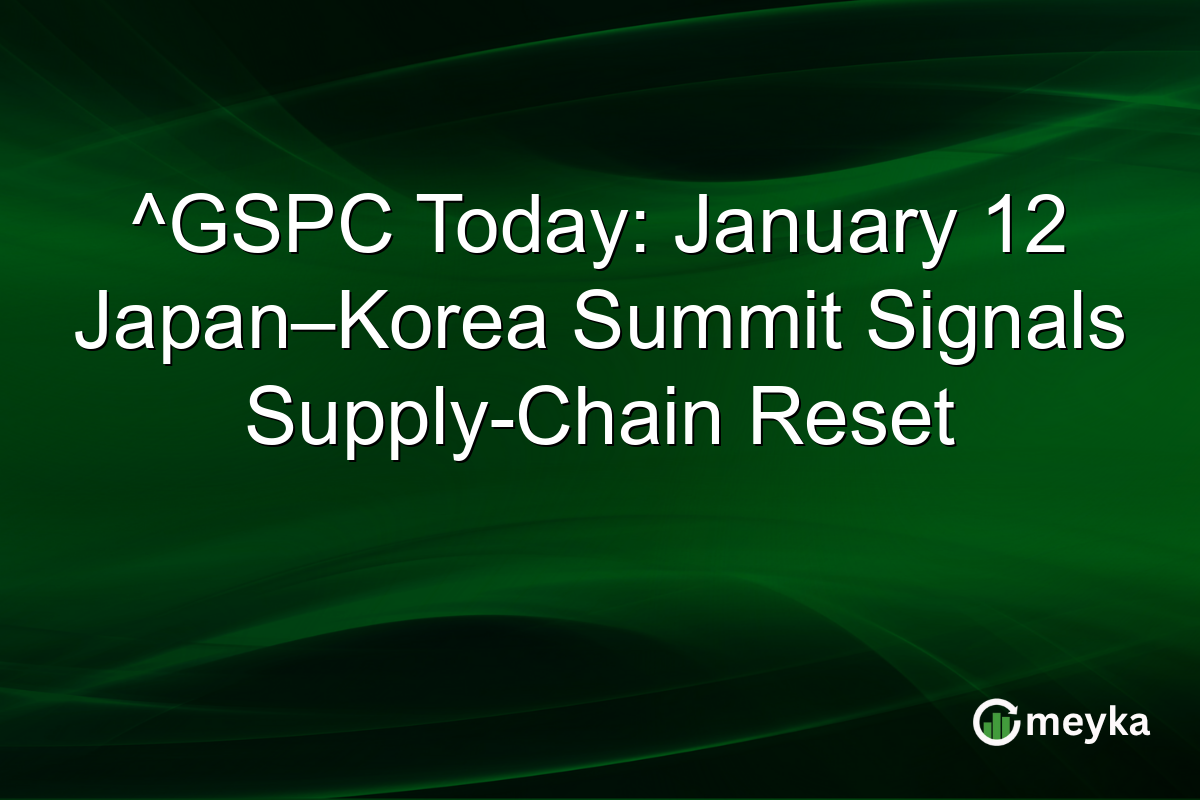
^GSPC Today: January 12 Japan–Korea Summit Signals Supply-Chain Reset

^GSPC Today: January 12 Japan–Korea Summit Signals Supply-Chain Reset

The Japan South Korea summit in Nara today could steady Northeast Asia ties and nudge U.S. risk appetite. Markets will watch messages on trade, supply chain security, and managing China and North Korea. The S&P 500 (^GSPC) last traded at 6,977.26, up 0.16%, after a 6,986.33 day high. Clear steps on CPTPP accession and coordination on critical inputs like rare earth magnets could ease bottlenecks and support U.S. autos, industrials, and semiconductors. We outline the policy angles and the setup for American portfolios.

Why this meeting matters for U.S. equities

Tokyo is hosting to consolidate a fragile reset with Seoul as China Japan tensions worsen. A steady channel between U.S. allies lowers policy uncertainty that has taxed procurement and compliance planning. Leaders aim to coordinate on history and trade issues while keeping focus on forward cooperation, which markets reward when messaging is credible. See context from ABC and Reuters for the diplomatic backdrop source source.

A constructive communique from the Japan South Korea summit would favor cyclical leadership. U.S. semiconductors, autos, machinery, and defense benefit if Asia supply lines and standards face fewer shocks. Reduced tail risk typically compresses equity risk premiums. Watch for language on export controls alignment and trade facilitation. Clear guardrails allow firms to plan inventory, tooling, and compliance budgets, supporting margin visibility for U.S.-listed suppliers tied to Japan and Korea ecosystems.

Trade and CPTPP: potential shifts in supply chains

Signals on CPTPP accession could tighten rules-of-origin links across a large Pacific bloc. For U.S. investors, that can mean steadier inputs from Japan and Korea into American plants via Mexico and Canada. The Japan South Korea summit may outline workstreams on customs, standards, and digital trade. Even without U.S. membership, predictable regional rules reduce frictions that have raised costs and delayed deliveries for U.S. manufacturers.

Markets will parse any plan to ease rare earth and permanent magnet bottlenecks that hit Japanese machinery and auto supply. If Japan and Korea coordinate sourcing and recycling, U.S. EV and wind supply chains may see fewer shocks. Supply chain security is the goal. Clear timelines on inventory buffers and supplier audits would reduce stoppage risk and support stable order books for U.S. component makers.

Security coordination and market sentiment

Tighter trilateral coordination with Washington on early warning, export screening, and crisis hotlines lowers the probability of disruptive missteps. The Japan South Korea summit can codify processes that investors model into lower downside scenarios. For markets, fewer surprises mean steadier multiples for globally exposed U.S. firms, especially where compliance costs and sanctions risks have forced conservative guidance.

Phrasing on China will drive sentiment. A calm tone that acknowledges China Japan tensions while prioritizing de-escalation and commerce reduces volatility. Seoul has noted that open disputes are not desirable for regional peace, which markets read as pragmatic. Clarity on maritime protocols and tech export guardrails would signal policy continuity that helps U.S. multinationals plan production and sales routes.

^GSPC technical setup and scenarios

The index trades near the upper Bollinger Band at 6,980.35 after a 6,986.33 high and 6,934.07 low. RSI 57.52 and MACD above signal (31.73 vs 28.95; histogram 2.78) show constructive momentum, while ADX 12.18 signals no strong trend. ATR is 59.05, implying modest intraday risk. Volume of 3.03B trails a 5.10B average, so confirmation requires stronger breadth and turnover.

A positive Japan South Korea summit outcome could test 6,980–6,988 resistance, with Keltner upper at 6,988.14. Pullbacks may find support near 6,866–6,870 mid-bands. Performance remains firm: 1D 0.14972, 1M 2.18662, 3M 6.47369, 1Y 19.54179. YTD is 1.72385. If guidance disappoints, look for mean reversion toward 6,752–6,752 band lows and monitor MFI 66.73 for overbought signals.

Final Thoughts

For U.S. investors, the Japan South Korea summit is a policy event with real cash-flow implications. Clear progress on standards, customs, and export screening would cut supply friction and lower tail risks for sectors tied to Northeast Asia. Watch for references to CPTPP accession steps, rare earth magnet sourcing, and joint crisis mechanisms. On the tape, ^GSPC sits near upper bands with constructive momentum but light volume, so confirmation matters. Practical checklist: read the communique language on trade facilitation and China references, track sector reaction in semis, autos, and machinery, and use 6,866–6,988 as today’s tactical range. Stay data-driven and avoid chasing gaps without stronger breadth.

FAQs

How could the Japan South Korea summit affect the S&P 500 today?

A cooperative message can lift risk appetite by lowering policy uncertainty in key Asian supply lines. That supports U.S. semiconductors, autos, and industrials. Near term, it could help the index probe resistance near 6,980–6,988 if breadth and volume improve. A vague or tense outcome could trigger mean reversion.

Why does CPTPP accession matter for U.S. investors?

If Seoul advances CPTPP accession, rules-of-origin and customs processes across the bloc become clearer. Even without U.S. membership, steadier Asian inputs can lower delays and compliance costs for American manufacturers. Predictable standards reduce inventory buffers and improve planning, which supports margins and valuation stability.

What does supply chain security mean in this context?

It means reliable access to critical parts and materials, timely shipping, and clear export rules. For investors, better security lowers the chance of production stoppages and surprise costs. That reduces downside scenarios in models and supports steadier earnings for companies linked to Japan and South Korea supply networks.

How do China Japan tensions factor into market risk?

Tense relations raise the odds of trade friction, inspections, or targeted controls that disrupt shipments. If summit language stresses de-escalation and guardrails, markets price lower tail risks. Clear protocols around maritime and tech trade reduce surprise shocks, which can support multiples for globally exposed U.S. companies.

Disclaimer:

The content shared by Meyka AI PTY LTD is solely for research and informational purposes.  Meyka is not a financial advisory service, and the information provided should not be considered investment or trading advice.

Similar Posts

Leave a Reply

Your email address will not be published. Required fields are marked *