TCS Q3 Results Show 3% Revenue Decline; HCL Reports Strong 5% Rise
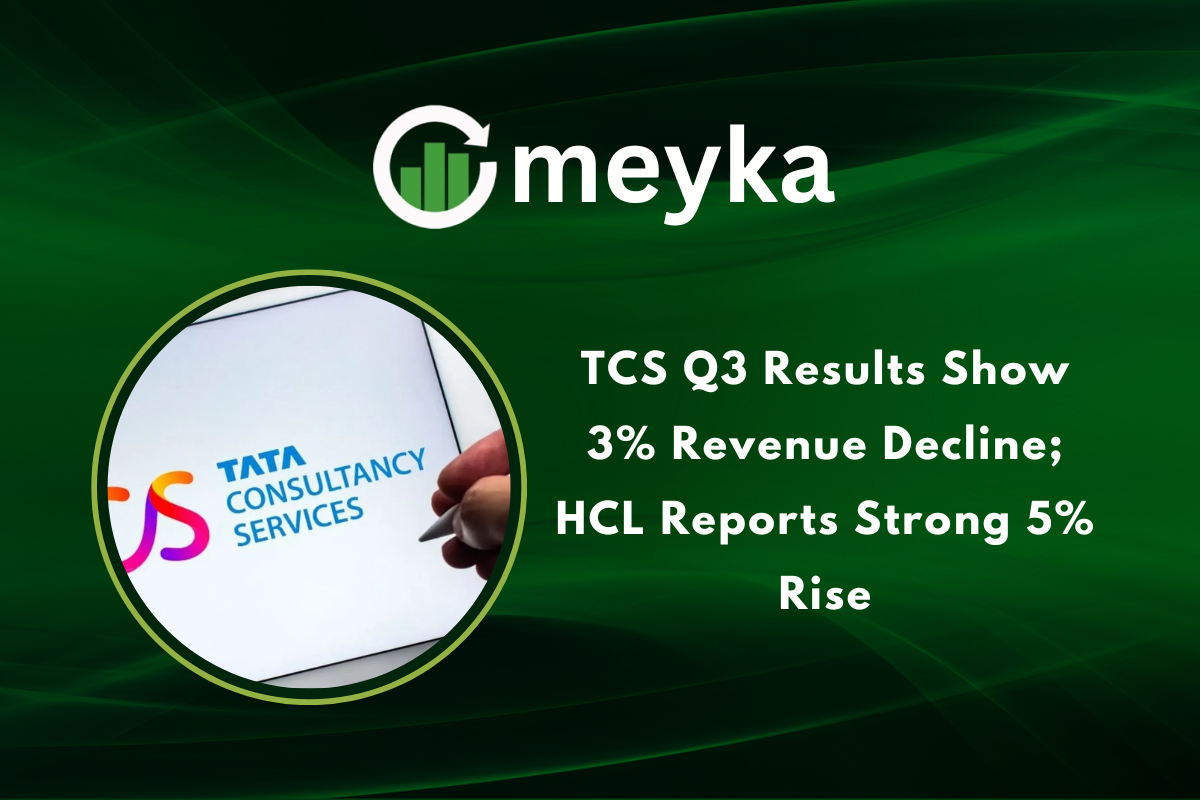
The latest earnings season has delivered a clear contrast within India’s IT sector. TCS Q3 results revealed a 3 percent sequential revenue decline, raising questions about near-term demand recovery, while HCL Technologies surprised markets with a strong 5 percent sequential revenue rise, driven by deal wins and better execution.
This divergence has become a key talking point for investors, analysts, and fund managers tracking Indian technology stocks. With global clients cutting discretionary spending and delaying large transformation projects, the sector is moving through a selective recovery phase rather than a broad-based rebound.
So what exactly happened in Q3, and what does it mean for the road ahead?
TCS Q3 Results Highlight Demand Pressure Across Key Markets
TCS Q3 results showed that the country’s largest IT services firm is still facing pressure from weak global demand, especially in North America and Europe.
In the December quarter, Tata Consultancy Services reported a 3 percent quarter-on-quarter revenue decline, reflecting slower deal ramp-ups and cautious client spending. Management pointed to delayed decision-making, particularly in banking, financial services, retail, and manufacturing.
Why are clients holding back?
The answer lies in macroeconomic uncertainty, higher interest rates, and tighter IT budgets. Many global companies are choosing to optimize existing systems instead of committing to large-scale digital projects.
Despite the revenue decline, TCS managed to protect margins through cost discipline, better utilization, and controlled hiring. However, analysts noted that growth visibility remains limited in the short term.
According to market watchers, the TCS Q3 numbers confirm that recovery is uneven, and large legacy IT players are feeling the impact first.
A market update shared by CNBCTV18News highlighted how investors reacted cautiously to the earnings, reflecting concerns over near-term growth momentum.
Key Takeaways From TCS Q3 Results
- Revenue declined around 3 percent sequentially due to delayed deal ramp-ups
- BFSI and retail verticals remained under pressure
- Margins stayed stable due to cost control
- Management maintained a cautious outlook for the next quarter
TCS Q3 Results and Deal Wins Signal Long-Term Stability
While the headline revenue number looked weak, TCS Q3 results were not entirely negative. The company continued to report healthy deal wins, especially in cloud modernization, cybersecurity, and enterprise automation.
Management emphasized that clients are still investing, but in smaller, outcome-driven projects instead of large multi-year programs. This shift is changing revenue recognition timelines and creating short-term volatility.
A post by Investor Feed noted that TCS remains well-positioned for long-term growth, even as near-term numbers remain soft.
From a long-term perspective, analysts believe TCS remains a core holding for conservative investors, given its balance sheet strength, global client base, and leadership in enterprise IT.
HCL Technologies Delivers Strong Q3 Performance
In sharp contrast, HCL Technologies reported a robust 5 percent sequential revenue growth in the same quarter, outperforming peers and market expectations.
HCL’s performance was driven by:
- Faster ramp-up of large deals
- Strong growth in software services
- Better execution in engineering and R and D services
While HCL’s net profit declined year on year due to wage hikes and higher costs, revenue momentum remained strong, signaling operational resilience.
According to ET NOW Live, the market welcomed HCL’s revenue beat, seeing it as a sign that selective growth pockets still exist within the IT sector.
Why Did HCL Outperform When TCS Slowed Down?
The difference lies in business mix and client exposure.
HCL has a larger share of product engineering and software services, which have seen steadier demand compared to traditional consulting-heavy models. Its focus on execution and faster deal conversion helped offset macro challenges.
A detailed breakdown shared by CNBCTV18Live explained how HCL’s strategy helped it stay ahead this quarter.
This divergence suggests that not all IT companies are affected equally, and stock-specific analysis is now more important than sector-wide bets.
IT Sector Outlook After TCS Q3 Results
So what does this mean for the broader IT sector?
The December quarter results show that growth is becoming selective, with companies that have:
- Strong execution
- Niche capabilities
- Faster deal ramp-ups
performing better than those dependent on large discretionary spending.
A market note shared by Bharat Equator highlighted that investors are now rotating within IT stocks rather than exiting the sector entirely.
Investor Perspective on TCS Q3 and HCL Performance
- Near-term volatility is likely to continue
- Deal pipelines remain healthy but cautious
- Stock selection matters more than sector allocation
- Earnings visibility improves gradually into the next fiscal year
How Should Investors Read TCS Q3 Results?
For investors, TCS Q3 results are a reminder that recovery will take time. The company remains fundamentally strong, but revenue growth may stay muted until global clients regain confidence.
Long-term investors focused on stability may still find value, while short-term traders could see limited upside until growth accelerates.
Some investors are using trading tools to track earnings momentum and relative performance within the IT space, especially during volatile result seasons.
Role of AI and Digital Transformation in IT Growth
Despite short-term headwinds, AI-driven transformation remains a long-term growth engine.
Companies like TCS and HCL are investing heavily in automation, cloud, and generative AI platforms. While this quarter did not reflect a major AI revenue boost, management commentary suggests stronger traction ahead.
Investors tracking the IT sector often combine earnings data with AI stock analysis to identify companies best positioned for the next growth cycle.
Market Sentiment and Analyst Views
Market sentiment remains mixed. Some analysts believe earnings downgrades are near the bottom, while others caution that recovery may stretch longer than expected.
A post by Niranjan Ghatule pointed out that valuations are now becoming more reasonable for quality IT names after recent corrections.
Meanwhile, AI Stock research continues to highlight IT services as indirect beneficiaries of enterprise AI adoption over the next two to three years.
Comparing TCS Q3 Results With HCL Performance
The comparison between TCS Q3 results and HCL’s growth highlights an important shift in the market. Execution, speed, and specialization are now more important than sheer size.
Another update from Bharat Equator emphasized that investors should focus on companies with faster revenue conversion cycles.
What Comes Next for TCS and HCL?
Looking ahead, both companies expect:
- Gradual improvement in client sentiment
- Better deal conversion in the next two quarters
- Continued focus on cost control and efficiency
The pace of global interest rate cuts and economic stability will play a major role in shaping demand.
Conclusion: TCS Q3 Results Reflect Transition Phase for IT Sector
The latest earnings season shows that India’s IT sector is in a transition phase. TCS Q3 results reflect short-term pressure, while HCL’s performance highlights opportunities for companies with the right mix and execution.
For investors, this is not a time for blanket assumptions. It is a phase that rewards patience, research, and selective exposure. As global conditions stabilize, leaders with strong fundamentals and adaptability are likely to emerge stronger.
FAQ’S
TCS Q3 results showed a revenue decline due to delayed client spending, slower deal ramp-ups, and cautious demand from banking, retail, and global enterprise customers.
HCL reported growth because of faster deal execution, strong software services demand, and better performance in engineering and digital transformation projects.
The decline appears short-term. Analysts believe TCS remains financially strong, with a solid deal pipeline and long-term growth potential once global demand improves.
TCS Q3 performance shows that the IT sector recovery is uneven, with growth depending on execution speed, service mix, and client exposure rather than company size.
Investors should focus on company-specific fundamentals, earnings visibility, and execution strength rather than making broad sector-based decisions.
Disclaimer
The content shared by Meyka AI PTY LTD is solely for research and informational purposes. Meyka is not a financial advisory service, and the information provided should not be considered investment or trading advice.