Gold Price Slips From Record Highs Near $4,900/oz After Trump Signals Greenland Deal
Gold price have been on a wild ride in January 2026. On January 21, 2026, gold briefly climbed to record highs near $4,900 per ounce, driven by rising fear in global markets. Investors rushed into gold as a safe haven when tensions flared between the U.S. and Europe over Greenland. Safe assets like gold often rise when markets fear uncertainty or conflict.
But things changed fast. On January 22, 2026, the rally lost some steam after U.S. President Donald Trump signaled a deal framework on Greenland and backed off tariff threats. This eased market fears and eased gold’s price pressure.
Today, gold looked softer than the day before, but still not far from its recent peak. This shift shows how much political moves can affect markets. Let’s explore why gold pushed so high, what turned it lower, and what could happen next for gold investors.
What Happened: Gold Price Near $4,900 Then Slipped
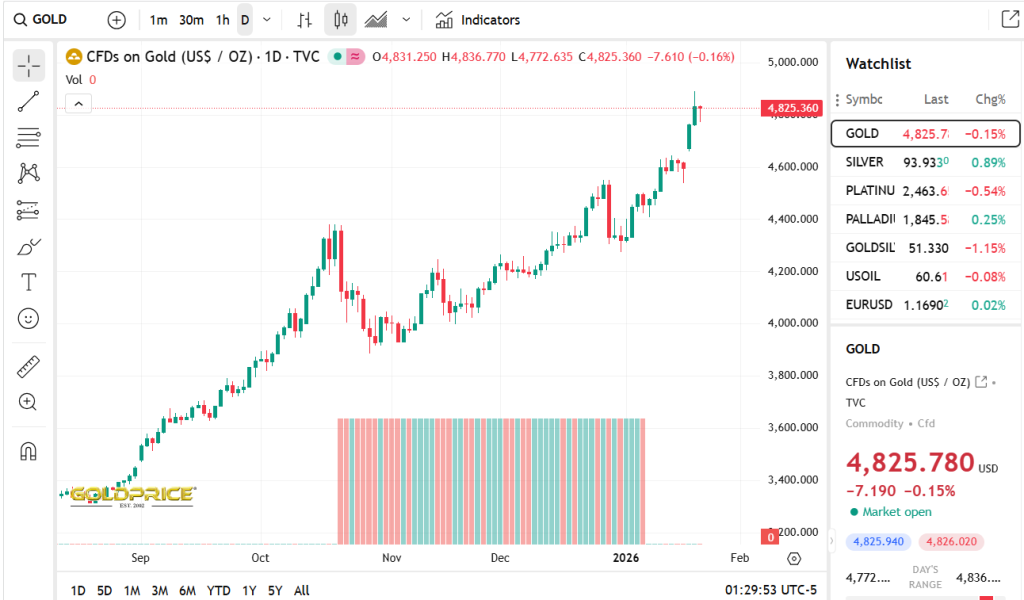
Gold prices made history on January 21, 2026, when spot gold surged to a fresh record high near $4,888 per ounce. The rally pushed prices close to the key psychological level of $5,000, a milestone many investors had only recently started to discuss seriously. The surge was driven by intense geopolitical risk and heavy demand for safe-haven assets.
However, the rally did not last long. On January 22, 2026, gold pulled back by nearly 1%, with spot prices falling to around $4,790-$4,800 per ounce. This move came after markets reacted to a shift in political tone from the United States.
According to Reuters, the pullback followed signs that tensions over Greenland were easing. This reduced fear in financial markets and lowered the urgency to hold gold for protection. Traders also locked in profits after several days of strong gains.
Why Did Gold Price Soar in the First Place?
Gold’s powerful rally did not happen by chance. The main driver was a sharp rise in global political risk linked to U.S.-Europe tensions over Greenland. Earlier in the week, U.S. President Donald Trump threatened tariffs on European countries that opposed U.S. plans related to Greenland.
These threats raised fears of a new trade conflict and damaged investor confidence. As a result, investors moved away from stocks and into traditional safe-haven assets such as gold. At the same time, the U.S. dollar weakened, which made gold cheaper for buyers using other currencies. This added more upward pressure on prices.
Reuters reported that gold climbed more than 2.5% in a single session, showing how fast money flowed into the metal during peak uncertainty. Analysts also pointed to long-term concerns such as rising government debt, central bank gold buying, and doubts about U.S. financial stability as reasons investors stayed bullish.
The Trump Greenland Factor: What Changed
The turning point came during the World Economic Forum in Davos. On January 22, 2026, President Trump signaled a softer stance. He ruled out the use of force and said a framework deal on Greenland was possible. He also stepped back from earlier tariff threats.
This change in tone quickly reduced geopolitical stress in markets. Investors became more willing to take risks again. Stocks rose, and the U.S. dollar strengthened. These shifts reduced the need to hold gold as protection.
Investing.com reported that gold slipped after Trump’s comments, as traders reassessed the level of risk priced into the metal. The market reaction showed how sensitive gold prices are to political headlines. Even small changes in diplomatic signals can move prices sharply.
Market Reaction Beyond Gold
The easing of tensions did not only affect gold. Global stock markets moved higher as risk appetite improved. Investors rotated back into equities, especially in the U.S. and Europe.
At the same time, the U.S. dollar gained strength. A stronger dollar usually puts pressure on gold because gold is priced in dollars. When the dollar rises, gold becomes more expensive for international buyers.
Other precious metals showed mixed moves. Silver stayed volatile after hitting record highs earlier in the week. Platinum and palladium also moved lower as traders focused more on economic growth and less on crisis protection.
Reuters noted that this broader shift reflected a classic “risk-on” move, where investors feel more confident and reduce exposure to safe-haven assets.
Technical and Sentiment Factors Driving the Gold Price Pullback
Technical trading also played a role in gold’s retreat. Prices had risen very fast over several sessions. This created overbought conditions in the short term. Many traders chose to take profits near record levels.
The area near $4,900-$5,000 is seen as a major psychological resistance zone. When prices approached this level, selling pressure increased. Support levels are now being watched near $4,750-$4,780.
Market sentiment also shifted as traders waited for key U.S. data, including inflation and jobless claims. These reports can affect expectations for Federal Reserve policy. If interest rate cuts are delayed, gold could face more pressure.
Analysts described the move as a healthy correction after a very strong rally, not a full trend reversal.
What Comes Next: Analyst Forecasts for Gold Prcie
Despite the pullback, many analysts remain positive on gold’s longer-term outlook. Goldman Sachs recently raised its forecast and now sees gold potentially reaching $5,400 by December 2026.
Experts say central bank buying, global political uncertainty, and concerns over debt and currency stability continue to support gold prices. If tensions rise again, safe-haven demand could return quickly.
Short-term moves may remain volatile. Prices will likely react to political headlines, U.S. economic data, and Federal Reserve signals. The path to $5,000 is still open, but it may not be smooth.
Final Words
Gold’s drop from near $4,900 per ounce reflects a fast change in market mood, not a collapse in demand. The pullback followed easing tensions over Greenland and a shift back toward risk-taking.
Even after the decline, gold remains near historic highs. This shows how strong the underlying trend still is. Political risk, central bank demand, and long-term economic uncertainty continue to support the metal.
For investors, the recent move highlights one key point. In today’s market, gold prices can change quickly based on headlines. Staying alert to global events will remain critical in the weeks ahead.
Frequently Asked Questions (FAQs)
Gold prices fell on January 22, 2026, after President Trump signaled progress on a Greenland deal. This reduced market fear and lowered demand for gold as a safe haven.
The rally is not considered over as of January 2026. The price drop is seen as profit-taking after strong gains, while global risks and central bank buying still support gold.
Yes, analysts say gold could reach $5,000 in 2026 if global tensions rise again or interest rates fall. However, prices may stay volatile in the short term.
Disclaimer
The content shared by Meyka AI PTY LTD is solely for research and informational purposes. Meyka is not a financial advisory service, and the information provided should not be considered investment or trading advice.