Adani Stocks Crash up to 15%, Investors Lose Rs 1.4 Lakh Crore Here’s What Went Wrong
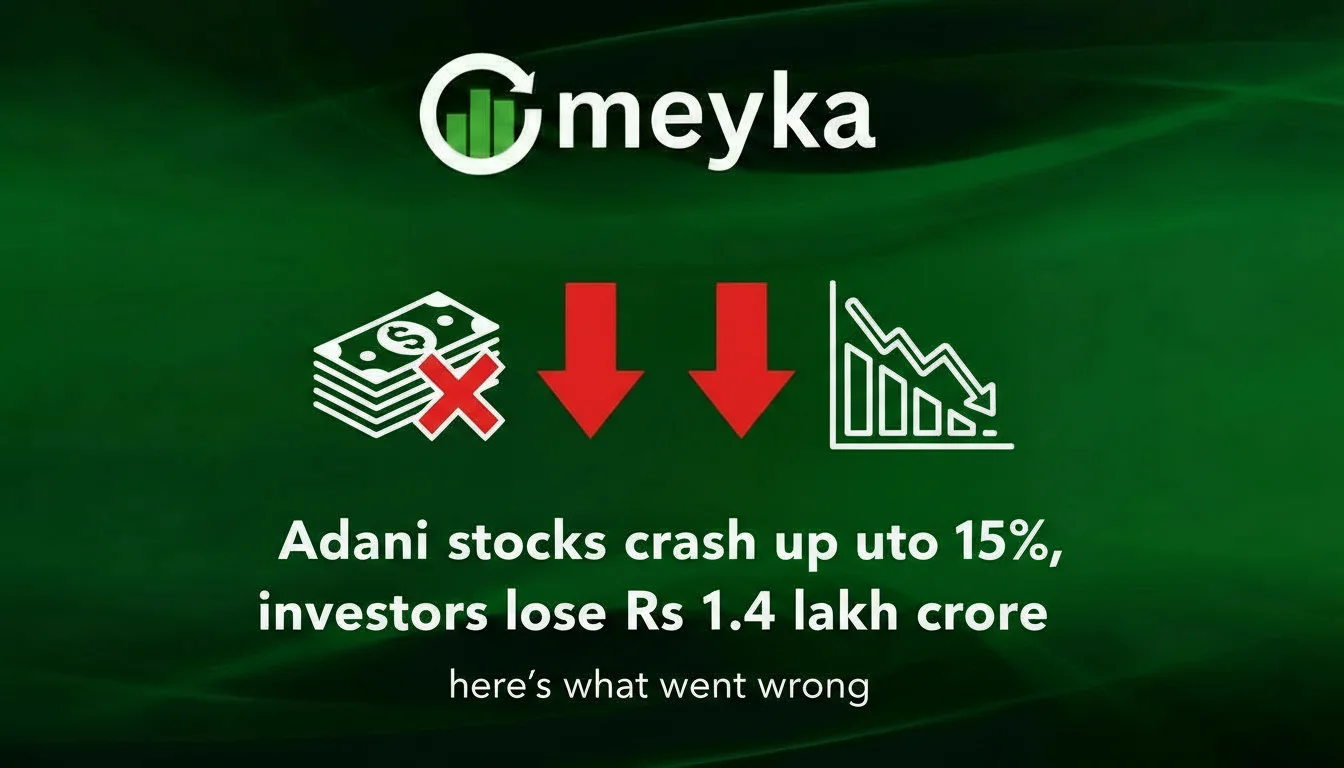
Adani stocks were hit hard on Friday as shares of major group companies fell up to 15 percent in single-day trading, wiping out about ₹1.4 lakh crore in investor wealth amid fresh legal concerns and market fear. The sharp downturn was one of the biggest sell-offs for the country’s largest corporate group, rattling both domestic and foreign investors and contributing to weakness in the broader stock market.
The steep fall in shares came after news emerged that the U.S. Securities and Exchange Commission (SEC) has moved to get court permission to serve legal summons on key Adani executives abroad, triggering a sharp drop in confidence among traders and fund managers. Adani Enterprises, Adani Green Energy, and Adani Energy Solutions were among the biggest losers.
Market Reaction: Sharp Sell-Off and Heavy Losses
On the day of the crash, Adani stocks slid deeply across the board. Shares of flagship Adani Enterprises dropped over 9 percent, while several others such as Adani Green Energy and Adani Energy Solutions fell sharply amid heavy trading pressure. Portfolio trackers showed millions of shares changing hands as institutional investors cut positions amid market fear.
The total erosion of market value of Adani’s listed stocks reached about ₹1.4 lakh crore in just one session, one of the most significant one-day declines for any Indian corporate group. Many of the group’s shares hit multi-month lows or their weakest levels since key regulatory scrutiny began.
Most analysts linked this sudden decline to concerns over possible legal challenges in the United States involving charges of alleged bribery and fraud linked to some contracts. Even though the Adani Group denied these allegations and called them “baseless”, investor sentiment weakened rapidly, and heavy selling pressure pushed prices lower.
Legal Pressure and Investor Fear
The unexpected trigger for the crash was legal news from the United States. The SEC sought approval from a U.S. court to serve legal summons to Gautam Adani, the group’s chairman, and Sagar Adani, a key executive, via email on alleged issues involving a $265 million bribery case. This development was widely reported in market sources and sparked major concerns among global investors about governance and regulatory risk.
This is not the first time legal and governance issues have affected Adani stocks. In past years, activist research reports and allegations about accounting and valuation practices drew heavy market attention, resulting in sharp drawdowns in Adani group stock prices and wiped out huge chunks of wealth.
Although the group continues to operate and has denied any wrongdoing, growing uncertainty around legal exposure and potential regulatory fallout caused a wave of selling by investors wary of concentration risk and corporate governance issues.
Why High Valuations Didn’t Help
Another factor that intensified the crash was valuation concerns. Some Adani shares historically traded at very high price-to-earnings (P/E) ratios compared with industry peers. Stocks that trade at high valuations relative to profits can see bigger percentage declines during corrections because their price multiples have more room to adjust if investors demand higher risk premiums.
For example, at certain points in recent years, some Adani stocks were among the highest-valued in terms of P/E ratios in Indian markets, above many technology and infrastructure peers. These lofty valuations added to market fear when governance and legal risk stories began to circulate again.
Impact on Broader Indian Stock Market
The sharp fall in Adani stocks did not happen in isolation. The broad market indices such as the Nifty 50 and Sensex were dragged lower as selling pressure in Adani companies weighed on sentiment in benchmark equity indexes. Stocks with heavy weights in major indices often have outsized influence when they move sharply in either direction.
Market participants including mutual funds and domestic portfolio investors that hold significant positions across sectors reported marked volatility throughout the session.
Analysts also noted that when a megacap group like Adani undergoes a sudden crash, broader market confidence can be affected as liquidity tightens and traders reallocate funds to safer assets or less-volatile stocks.
Investor Losses and Wealth Erosion
The astonishing ₹1.4 lakh crore loss in market value translates into significant wealth erosion for both retail and institutional investors. Those who held Adani shares near recent highs suffered sharp paper losses as the market repriced risk.
Some foreign institutional investors reduced exposure to the group fearing wider regulatory risk and funding uncertainties. Domestic mutual funds also made tactical shifts to limit downside exposure amid heavy selling.
Losses on this scale can affect market psychology and investor confidence in risk assets for weeks or months, particularly when the trigger is perceived legal or regulatory problems rather than purely cyclical economic factors.
Is This a Short-Term Sell-Off or Structural Change?
One of the key questions for investors now is whether the sell-off will be short-lived or reflect deeper structural issues.
Short-Term Reaction Factors
- Rapid selling in response to a specific legal development
- High volatility as investors rush to de-risk portfolios
- Market linkage effects where index declines amplify selling pressure
Longer-Term Structural Risks
- Corporate governance concerns perceived by institutional investors
- Elevated borrowing and debt levels in certain group companies
- Potential impact of legal rulings on investment reputation
Stock research experts note that while price volatility is a normal part of the equity cycle, prolonged negative sentiment can weigh on growth prospects if capital inflows slow or if borrowing costs rise for the group.
What Investors Should Watch Next
Investors and traders watching Adani stocks should keep an eye on several key indicators going forward:
- Legal developments and how regulatory bodies respond
- Quarterly earnings and debt levels for core group companies
- Investor sentiment and foreign portfolio flows into Indian equities
- Valuation metrics such as P/E ratios compared with industry norms
- Broader stock market trends and sector rotation patterns
A sustained rebound would likely require renewed confidence in governance practices, clearer legal outcomes, and a return to positive earnings growth.
Conclusion
The sudden crash in Adani stocks and the resulting wipeout of ₹1.4 lakh crore in market value was triggered largely by fresh legal concerns and fear-driven selling. While the Adani Group remains operationally strong in many segments of infrastructure and energy, market perception and risk appetite have shifted dramatically. Investor confidence can be fragile when valuation levels are high and external legal challenges emerge, leading to swift volatility in share prices.
As the situation evolves, careful stock research, risk management, and attention to fundamental business performance will be key for those invested in or watching this major Indian corporate group.
Frequently Asked Questions
The sharp fall was largely triggered by news that the U.S. Securities and Exchange Commission sought court approval to serve legal summons on Adani executives, stoking concerns about potential legal risk.
Market value of Adani Group stocks fell by roughly ₹1.4 lakh crore in a single trading session as shares lost up to 15 percent.
It depends on legal outcomes, investor confidence, and how the group manages debt and governance issues. Long-term trends will be shaped by earnings performance and broader market conditions.
Disclaimer:
The content shared by Meyka AI PTY LTD is solely for research and informational purposes. Meyka is not a financial advisory service, and the information provided should not be considered investment or trading advice.