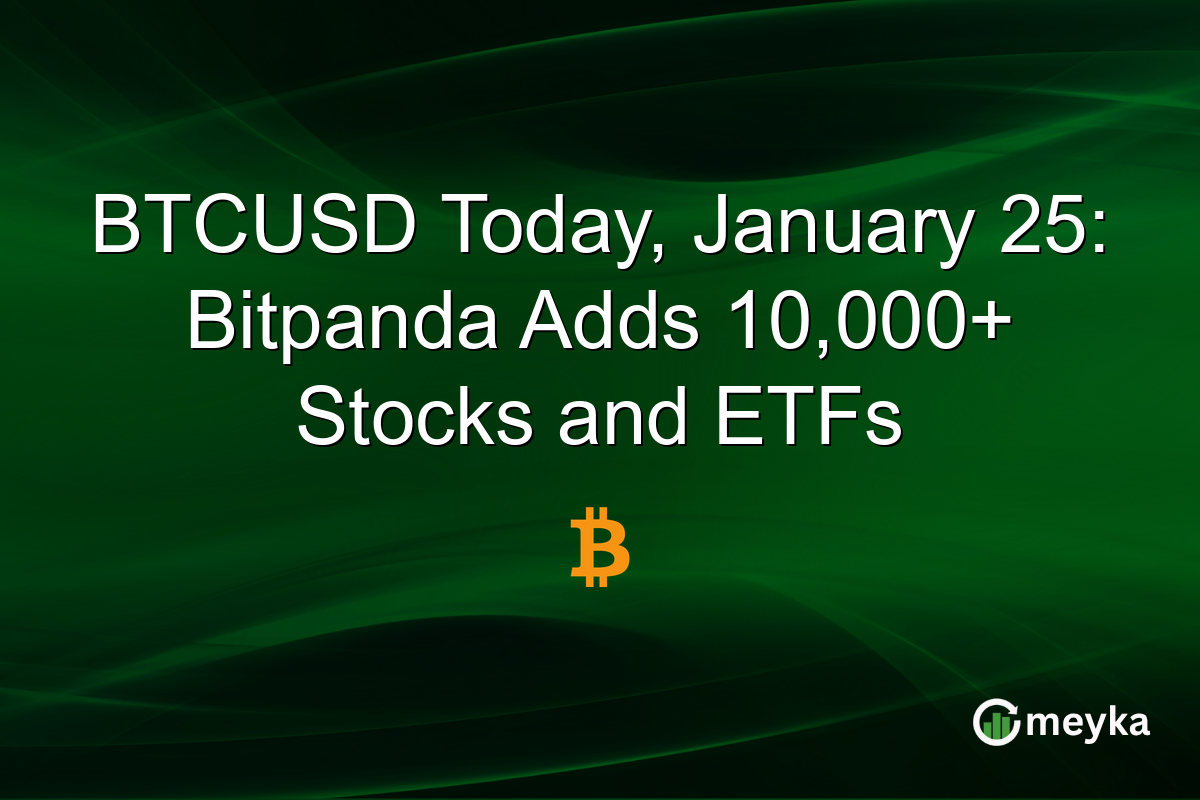
BTCUSD Today, January 25: Bitpanda Adds 10,000+ Stocks and ETFs

BTCUSD Today, January 25: Bitpanda Adds 10,000+ Stocks and ETFs

Bitpanda will add 10,000+ traditionally regulated stocks and ETFs to its app on January 29, placing stock and ETF trading next to crypto and metals with a flat €1 fee and fractional shares. For Swiss investors, one login for diversified orders could change habits. For BTCUSD traders, cross‑asset flows on a regulated investment app may shift liquidity during Europe hours. The company also targets a Frankfurt IPO in H1 2026. We outline the launch details, Swiss considerations, and key BTC levels to watch today.

What launches on January 29

Bitpanda is introducing access to 10,000+ traditionally regulated stocks and ETFs within the same interface as crypto and metals. Orders will execute during exchange hours while crypto remains 24/7. This combines watchlists, funding, and statements in one place. The move follows Europe’s push toward full‑stack apps, according to The Block.

The app will charge a flat €1 per trade for stock and ETF trading. Fractional shares enable small tickets without minimums, useful for high‑priced US names. Pricing simplicity may appeal to cost‑focused retail users. Execution quality, spreads, and FX conversion still matter for net outcomes, especially when buying non‑euro assets from Swiss franc accounts.

The company will automatically remit taxes in Germany and Austria, per disclosures in coverage. Swiss users should plan for their own reporting, as local rules differ from EU systems. Keep an eye on market hours, order types, and potential venue routing. One screen for assets can reduce friction, but investors should compare total cost and execution quality across providers.

Why it matters in Switzerland

We see a shift when stocks, ETFs, crypto, and metals sit side by side. Swiss investors can rebalance faster between equity ETFs and coins without moving funds across platforms. That could change intraday behavior, especially around European and US opens. Fewer transfers can lower friction, but discipline on allocation and risk sizing becomes even more important.

For Switzerland, a euro‑denominated €1 fee is simple but not the whole picture. FX spreads, conversion charges, and ETF domicile can influence total cost. Compare all‑in costs with domestic brokers and check KID availability. Track bid‑ask spreads during less liquid times. A low ticket fee helps small orders, but large trades still need price‑improvement focus.

Tax remittance automation applies to Germany and Austria, not Switzerland. Swiss residents should keep accurate records for income and wealth tax filing. Download statements regularly, label transfers, and note realized versus unrealized items. Check if the app offers Swiss tax exports. When in doubt, ask a tax advisor before year‑end to avoid rushed corrections.

BTCUSD levels and flow watch

BTCUSD trades near $89,009.34, down 0.51% on the day, with a range of $88,941.99 to $89,177.95. Price sits below the 50‑day average at $90,220 and well under the 200‑day at $105,438. RSI is 48.91 and ADX 25.89, signaling a moderate trend. Bollinger middle band is $88,709, with upper at $93,209 and lower at $84,209. Keep risk tight near these bands.

If users shift between equity ETFs and crypto in one app, we may see tighter timing of flows near cash equity opens. That can affect spreads and short‑term volatility on major pairs. Watch order‑book depth and funding rates on launch week. Small equity buys via fractional shares could also free capital that rotates into crypto on strong momentum days.

Competition and the 2026 IPO angle

Europe’s trading apps are moving toward full‑stack investing with stocks, ETFs, and crypto under one roof. Bitpanda’s roadmap includes a targeted Frankfurt IPO in H1 2026, putting scale, compliance, and unit economics in focus. Early adoption metrics after the stock and ETF launch will matter for investor narratives, as noted by Trending Topics.

We would track user activity around January 29, ticket sizes in ETFs, and any shifts in crypto volumes during Europe hours. Compare effective spread plus fee versus domestic alternatives. Look for roadmap updates on order types, market data, and Swiss tax support. Competitive responses from brokers and exchanges could compress fees and improve execution quality.

Final Thoughts

Bitpanda’s expansion blends stock and ETF trading with crypto and metals in one place. For Swiss investors, it may reduce friction, but total cost still depends on spreads, FX, and taxes. For BTCUSD traders, cross‑asset behavior could cluster flows near equity market opens, affecting short‑term volatility. Our takeaways: confirm availability and fee schedules in your region, test small orders to gauge execution, and keep clean records for Swiss tax filing. Watch $88,700 to $93,200 as key bands, the 50‑day average near $90,220, and sentiment into the January 29 rollout. Adjust position sizing if volatility picks up on launch week.

FAQs

What exactly is Bitpanda adding on January 29?

The app will offer access to 10,000+ traditionally regulated stocks and ETFs inside the same interface as crypto and metals. Users can place equity orders during exchange hours, with a flat €1 fee per trade and fractional shares available. This combines watchlists, funding, statements, and rebalancing in one place, reducing friction across assets.

How could this affect BTCUSD in the short term?

When stock and ETF trading sits alongside crypto, order timing can cluster around equity market opens. That can influence spreads and intraday volatility in BTCUSD. Watch the Bollinger band levels around $88,700 and $93,200, the 50‑day average near $90,220, and overall liquidity during the launch week to manage risk.

What should Swiss investors check before using the new features?

Review all‑in costs, not just the €1 fee. Compare FX conversion, spreads, ETF domicile, and reporting. Tax remittance automation covers Germany and Austria, not Switzerland. Ensure you can export statements suitable for Swiss filing. Start with small tickets to test execution quality during your usual trading hours.

Are fractional shares useful for Swiss portfolios?

Yes. Fractional shares in Europe can help build diversified positions with smaller amounts. They allow precise rebalancing into high‑priced US stocks or sector ETFs. This is helpful for cost averaging and for sizing positions around risk limits. Still, track spreads, FX, and trading hours to avoid avoidable slippage.

Disclaimer:

The content shared by Meyka AI PTY LTD is solely for research and informational purposes.  Meyka is not a financial advisory service, and the information provided should not be considered investment or trading advice.

Similar Posts

Leave a Reply

Your email address will not be published. Required fields are marked *