FTSE 100 Falls as US Stocks Slide and Bonds Jump on Trump’s Greenland Threats
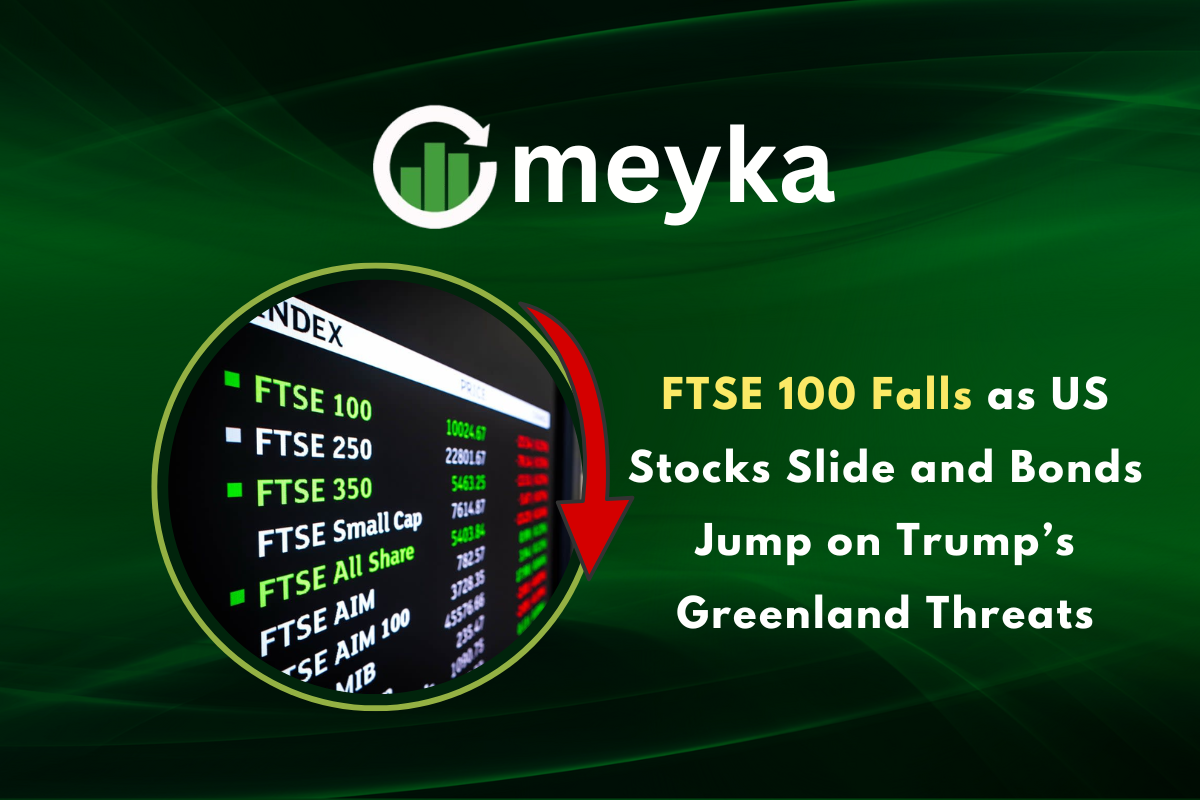
The FTSE 100 slipped sharply today as global markets reacted to fresh geopolitical tension linked to former US President Donald Trump’s comments on Greenland. The selloff in London followed a steep fall in US stocks, a strong rally in government bonds, and a sudden shift toward safe-haven assets.
Investors moved fast. Risk appetite weakened. Money flowed out of equities and into bonds, gold, and defensive positions. The FTSE 100, which is closely linked to global trade, commodities, and financial flows, felt the pressure early in the session.
This move was not just about the UK market. It was a clear sign that global investors are worried about rising political risk, trade tension, and uncertainty ahead of key global meetings.
Let us explain what happened, why it matters, and what investors should watch next, using clear language and real market context.
FTSE 100 Today: What Triggered the Market Drop
The FTSE 100 opened lower and stayed under pressure throughout the session as negative cues arrived from the US overnight. Wall Street saw a broad selloff, with major indexes sliding as bond yields jumped sharply.
The main trigger was renewed concern over geopolitical risk after Donald Trump made strong comments related to Greenland. Markets interpreted the remarks as a potential threat to global stability and trade cooperation, especially ahead of major international talks in Davos.
Why does this matter to markets?
Geopolitical uncertainty increases risk. When risk rises, investors sell equities and buy bonds. That is exactly what happened today.
A market observer shared this view on social media, noting that European stocks were reacting more to global fear than domestic data.
How the US Market Weakness Hit the FTSE 100
The FTSE 100 often follows the direction of US markets, especially during global risk events. Overnight, US stocks fell as investors reassessed growth expectations and political stability.
At the same time, US Treasury yields dropped sharply as bond prices rose. This bond rally showed that investors were seeking safety.
When US bonds rally and stocks fall, global equity markets usually follow. London was no exception.
A UK market analyst pointed out that the FTSE 100 was tracking US futures closely during the session, with every dip in US stocks pushing London lower.
Why Trump’s Greenland Comments Shook Global Markets
Trump’s comments on Greenland revived memories of earlier trade disputes and diplomatic tensions. Markets dislike surprises, especially when they involve major powers and strategic regions.
Greenland has geopolitical importance due to its location and resources. Any hint of tension around it raises broader concerns about alliances, trade routes, and global cooperation.
Investors worry that such statements could lead to tougher trade policies or diplomatic strain, which would slow global growth.
A global news account highlighted how quickly markets reacted once the comments gained attention.
Sector-Wise Impact on the FTSE 100
Not all stocks fell equally. The FTSE 100 saw clear sector rotation during the session.
Cyclical Stocks Under Pressure
Mining, banking, and energy stocks led the losses. These sectors depend heavily on global growth and stable trade relations.
Banks fell as bond yields dropped, which reduced profit margins. Miners declined as commodity prices weakened on fears of slower demand.
Defensive Stocks Offered Some Support
Consumer staples and healthcare stocks held up better. These sectors are seen as safer during uncertain times.
Still, their gains were not enough to offset the broader market weakness.
A trader noted on social media that defensive buying helped limit losses, but fear was still dominant.
Bond Market Surge and What It Signals
One of the most important signals today came from the bond market.
UK government bonds, also known as gilts, saw strong buying. Yields fell sharply, showing that investors were prioritizing safety over returns.
This bond rally matters because it reflects fear. When investors expect economic trouble or political risk, they move into bonds.
The bond move also added pressure on the FTSE 100, especially financial stocks.
A market-focused account pointed out that the bond rally was one of the strongest seen in recent weeks.
Currency Moves Added to Market Volatility
The British pound remained firm against the US dollar despite the equity selloff. This unusual combination added pressure on exporters within the FTSE 100. A strong pound makes UK exports more expensive abroad, which hurts companies that earn in foreign currencies.
This currency effect made the equity decline deeper for some multinational firms.
FTSE 100 and Global Risk Sentiment
The FTSE 100 is often seen as a global index, not just a UK one. Many of its companies earn revenue overseas. That is why global risk events hit it hard.
When global confidence falls, the FTSE 100 usually reacts quickly. This session showed how closely connected markets are. A comment in the US led to bond moves, stock falls, and currency shifts across Europe within hours.
Key Data Points Investors Watched Today
Market Snapshot
- The FTSE 100 fell by over one percent during the session
- US stock futures remained weak through European trading hours
- UK bond yields dropped sharply as demand rose
- Defensive sectors outperformed cyclical ones
Investor Reactions
- Risk-off positioning increased
- Equity exposure reduced
- Safe-haven demand rose
These moves together paint a clear picture of fear-driven trading.
Questions Investors Are Asking Right Now
Is this a short-term panic move?
At this stage, it looks like a risk-driven reaction rather than a fundamental collapse. However, continued political tension could extend the move.
Will the FTSE 100 recover quickly?
Recovery depends on how global markets react next. If US stocks stabilize and political rhetoric cools, a bounce is possible.
FTSE 100 Technical Levels to Watch
From a technical view, the FTSE 100 has broken below key short-term support.
Immediate support lies near recent weekly lows. A deeper fall could test levels seen earlier this month. Resistance now stands near the previous session highs. The index needs positive global cues to move higher again.
Traders are watching volume closely to see if selling pressure fades or intensifies.
How Institutional Investors Are Responding
Institutional investors appear cautious but not panicked. Many funds reduced exposure slightly rather than exiting fully. This suggests portfolio rebalancing rather than full risk exit.
Some funds are using advanced trading tools to manage volatility and adjust positions in real time.
Others rely on macro signals combined with AI Stock research to identify stress patterns early. A few large desks are also testing selective AI stock analysis models to understand cross-asset correlations during geopolitical shocks.
These tools help institutions react faster while avoiding emotional decisions.
Comparison With Past Geopolitical Market Reactions
Markets have seen similar reactions during past geopolitical events. Short-term fear leads to selloffs, followed by partial recoveries if tension eases. However, repeated political shocks can weaken confidence over time.
This is why investors are watching headlines closely.
What Long-Term Investors Should Consider
Long-term investors should focus on fundamentals, not headlines alone.
The FTSE 100 still offers strong dividend yields and exposure to global growth. Short-term volatility does not change that overnight. However, managing position size and risk is important during uncertain times.
Gradual allocation changes often work better than sudden moves.
FTSE 100 Outlook: What Comes Next
The short-term outlook remains uncertain. Markets will react to:
- Further political comments
- US market direction
- Bond yield movement
- Signals from global leaders
If tensions ease, the FTSE 100 could recover part of today’s losses. If not, volatility may stay elevated.
Why Today’s Move Matters Beyond One Session
This was not just a bad day for stocks. It was a reminder of how sensitive markets are to political risk.
The FTSE 100 acted as a mirror of global fear. Bond markets confirmed it. Understanding these signals helps investors make better decisions.
Conclusion
The FTSE 100 fell as US stocks slid and bonds surged following renewed geopolitical concerns linked to Trump’s Greenland remarks. The move reflected a clear shift to safety, not just in the UK but across global markets.
While fear drove today’s action, long-term fundamentals remain intact. The coming days will depend on how global leaders respond and whether risk appetite returns.
For now, caution rules the market, and patience matters more than panic.
FAQ’S
The FTSE 100 fell due to global risk concerns after US stocks declined and investors rushed into bonds following geopolitical tension linked to Trump’s comments on Greenland.
US stocks slid sharply, which weakened global investor confidence. This led to selling pressure in the FTSE 100, especially in sectors linked to global growth.
Investors moved money into government bonds as safe assets. This shift happens when markets fear political or economic uncertainty.
Banks, miners, and energy stocks faced the most pressure due to falling bond yields, weaker commodity prices, and concerns about slower global growth.
Recovery depends on easing geopolitical tension and stabilization in US markets. If global risk sentiment improves, the FTSE 100 could regain some losses.
Disclaimer
The content shared by Meyka AI PTY LTD is solely for research and informational purposes. Meyka is not a financial advisory service, and the information provided should not be considered investment or trading advice.