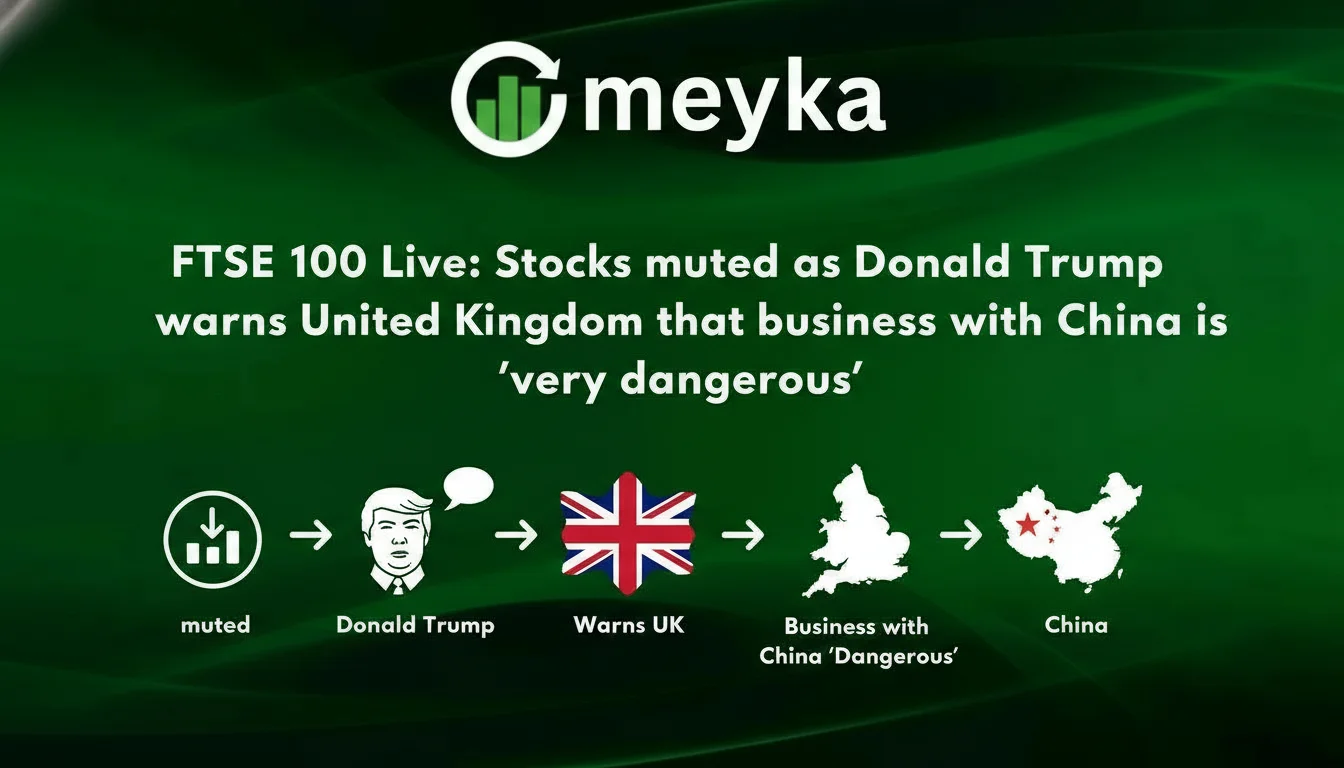
FTSE 100 Live: Stocks Muted as Donald Trump Warns United Kingdom that Business with China is ‘Very Dangerous
Global markets saw cautious trading this week as the FTSE 100 index remained subdued while geopolitical tensions between the United States, the United Kingdom, and China took centre stage, with U.S. President Donald Trump issuing strong warnings about commercial ties with Beijing.
Investors and traders around the world are weighing the impact of political rhetoric on economic growth, trade relations, and stock market performance, particularly in the UK where the blue‑chip index has shown resilience despite muted trading sessions.
FTSE 100 Trading Environment: Calm Amidst Political Noise
Today’s session on the London Stock Exchange saw the FTSE 100 hovering with modest gains and limited momentum as broader market sentiment remained cautious. Despite positive earnings from several major companies, broader indexes failed to gain strong traction. The cautious mood comes as investors process recent geopolitical news and attempt to gauge longer‑term economic implications.
The FTSE 100’s subdued movement reflects how global politics, especially trade policy warnings and diplomatic interactions, can influence investor decisions even when corporate earnings data is solid. In particular, markets reacted to statements from Trump expressing concern about the UK’s business engagement with China.
Trump’s Warning on UK‑China Business Ties
U.S. President Donald Trump openly cautioned the United Kingdom against pursuing closer business ties with China, describing such trade relationships as “very dangerous.” His comments came in response to UK Prime Minister Keir Starmer’s visit to Beijing, where Starmer aimed to strengthen economic relations, reduce tariffs, and improve market access for British companies. Trump’s remarks signal a broader tension in transatlantic economic strategy and geopolitics between the world’s leading economies.
Trump’s position reflects longstanding skepticism from some U.S. policymakers about deepening economic engagement with China, particularly at a time when relations between Washington and Beijing are strained due to trade disputes, national security concerns, and competition over emerging technologies. His warning also extended to Canada, which has similarly pursued closer trade engagements with China.
Impact of Geopolitics on the UK Economy and FTSE 100
The UK government responded to Trump’s warnings by stressing that London’s trade strategy seeks balanced relations with a range of partners without compromising its alliances. The standoff underlines how political discourse can shape investor expectations, especially for indexes like the FTSE 100, which includes multinational companies with extensive global operations.
Investors must consider how these geopolitical developments can affect trade flows, export opportunities, and corporate growth prospects. For blue‑chip firms, extended tariffs or trade restrictions could raise operational costs or limit market access, potentially impacting future revenues and investor sentiment.
Market Dynamics Around the FTSE 100 Index
The FTSE 100 represents the performance of the largest UK‑listed companies by market capitalisation. It includes a diverse mix of sectors such as finance, energy, consumer goods, and materials. As a benchmark index, its performance often reflects broader economic conditions, currency movements, and global trade trends.
In recent sessions, muted movement in the FTSE 100 suggests that traders may be waiting for clearer signals from policymakers before committing to more aggressive positioning. For example, uncertainty over how the UK will balance relations with both the U.S. and China has introduced a level of hesitation among investors, particularly those paying close attention to trade and economic forecasts.
The Role of Trade Policy in Global Markets
Trade policy statements and warnings from world leaders can have ripple effects across global markets. When influential voices like President Trump issue cautionary messages about bilateral trade, equities globally can experience heightened volatility. This is because trade agreements and relationships influence export‑oriented revenue streams, supply chains, and corporate profitability.
For markets like the FTSE 100, which hosts many internationally‑focused companies, any perception of trade disruption can dampen investor enthusiasm and lead to sideways trading. Higher tariffs or strained diplomatic ties can reduce the value of exports, disrupt supply lines, and lead to coping strategies that investors must assess in their stock research routines.
Investor Sentiment and Future Expectations
Despite Trump’s warnings, some investors believe that UK–China economic engagement can still progress without harming strategic alliances. They point to ongoing negotiations on reduced tariffs and mutual cooperation in key sectors such as technology or finance as evidence that nations can maintain diversified trade relationships.
However, risk‑averse traders continue to monitor developments closely, as statements from senior political figures can influence how capital flows are allocated across markets, including the FTSE 100. Investors looking at AI stocks and other sector‑specific trends must also incorporate broader macroeconomic headwinds like geopolitics into their modelling and forecasts.
Broader Implications Beyond the UK Market
Geopolitical tensions and trade warnings are not limited to the FTSE 100’s influence. Global equity markets are interconnected, and investor reactions in London can coincide with price movements in New York, Hong Kong, and other major financial centres. Suspicion around China trade engagement may also shift capital flow patterns toward markets perceived as more secure or less politically exposed.
For example, changes in trade policy can influence currency values, inflation expectations, and consumer demand, which in turn affect corporate earnings and equity valuations across the global stock market. Traders conducting thorough stock research need to incorporate geopolitical risks as part of their risk management frameworks.
Outlook for the FTSE 100 and UK Markets
Looking ahead, the direction of the UK’s relations with China and the U.S. will likely remain a key focus for analysts and investors. Should diplomatic relations improve and trade agreements materialise, the FTSE 100 could benefit from revived optimism and increased investor confidence. Conversely, prolonged political discord may keep markets tempered and cautious.
Central to this outlook are future policy statements, tariff decisions, and reciprocal trade actions that could either alleviate or exacerbate investor concerns. Until a clearer path emerges on trade and diplomacy, the FTSE 100 may continue to exhibit muted performance in response to global political developments.
Frequently Asked Questions
The index remains subdued due to investor caution following geopolitical warnings from U.S. President Donald Trump about UK business relations with China and ongoing uncertainty in global trade dynamics.
Political rhetoric about trade relations can influence investor confidence, which affects capital flows, corporate outlooks, and stock valuations, often leading to cautious or sideways trading.
Yes, geopolitical developments can significantly influence market sentiment and financial outcomes, so they should be factored into comprehensive stock research and investment strategies.
Disclaimer:
The content shared by Meyka AI PTY LTD is solely for research and informational purposes. Meyka is not a financial advisory service, and the information provided should not be considered investment or trading advice.