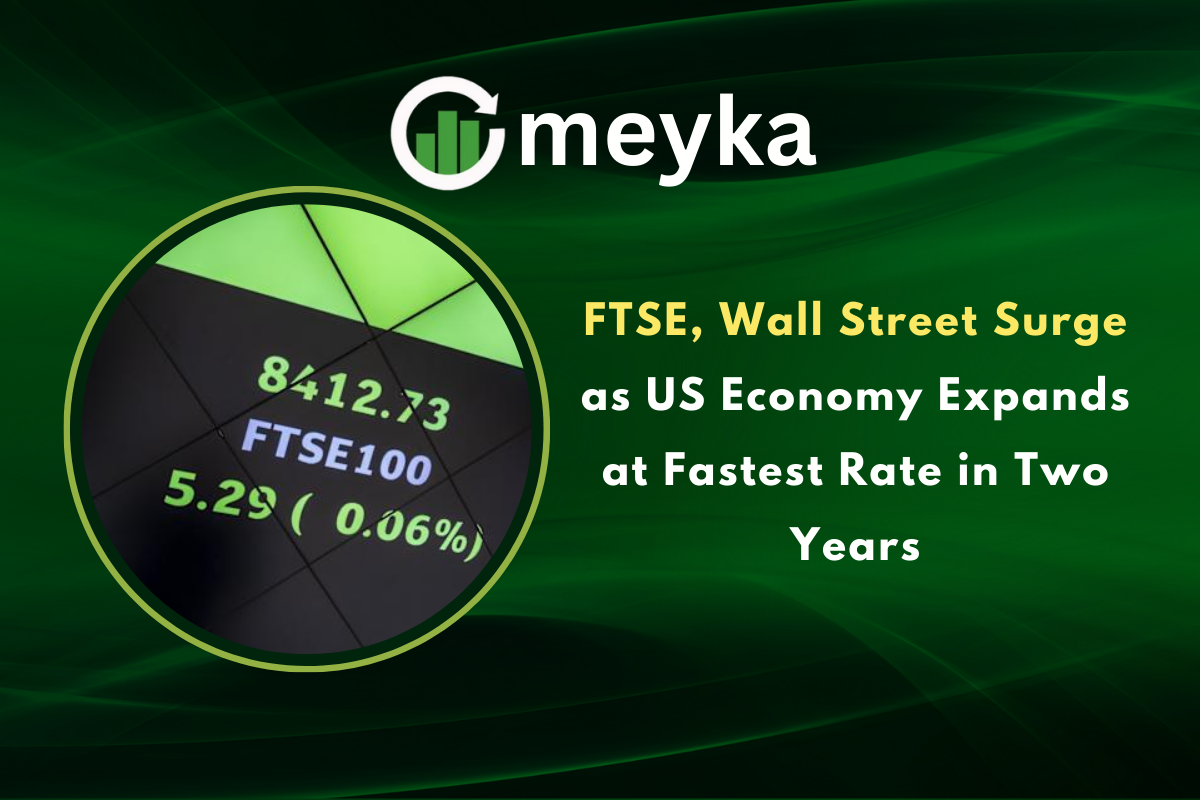
FTSE, Wall Street Surge as US Economy Expands at Fastest Rate in Two Years
Global markets ended the week on a strong note as the FTSE and Wall Street surged after fresh data showed the US economy expanded at its fastest pace in two years. The stronger growth numbers eased fears of an economic slowdown and gave investors a clear reason to step back into equities.
From London to New York, stocks moved higher as confidence improved around consumer spending, business investment, and the broader outlook for interest rates. The rally was broad-based, with banking, technology, energy, and consumer stocks all seeing healthy buying interest.
Why does this data matter so much?
Because the United States remains the world’s largest economy, and its growth often sets the tone for global markets. Strong US data usually supports risk assets across Europe and Asia.
Let us break down what happened, why markets reacted so positively, and what it could mean for investors going forward.
FTSE Rises as Global Risk Appetite Improves
The FTSE 100 opened higher and extended gains through the session, tracking strong overnight moves on Wall Street. Investors welcomed signs that the US economy remains resilient despite higher interest rates and global uncertainty.
London’s benchmark index was supported by gains in heavyweight sectors such as financials, miners, and energy stocks. Companies with large exposure to the US market also benefited as growth expectations improved.
According to market data, the FTSE 100 moved closer to recent resistance levels as buyers returned after weeks of cautious trading. Mid-cap stocks also saw renewed interest, reflecting broader confidence in global demand.
Why did the FTSE react so strongly to US data?
Many FTSE-listed companies earn a significant share of revenue from the United States. Faster US growth improves earnings visibility and supports higher valuations.
The positive mood was reflected widely on social media, where traders and commentators highlighted the shift in sentiment.
That post summed up the optimism around global equities following the growth surprise.
US Economy Grows at Fastest Pace in Two Years
The key trigger for the rally was new data showing that US gross domestic product rose at an annualized pace of around 3 percent, marking the fastest growth rate in two years. This figure came in well above market expectations and signaled strong momentum in the world’s biggest economy.
Growth was driven by resilient consumer spending, solid business investment, and improving exports. Government spending also added support, while inflation pressures showed signs of easing.
Key Drivers Behind the Strong US GDP Print
• Consumer spending remained firm, supported by steady job growth and wage gains
• Business investment improved, especially in technology and infrastructure
• Exports benefited from stable global demand
• Inflation slowed enough to avoid choking off growth
This combination helped ease fears that higher borrowing costs would push the economy into recession.
Why is this important for markets?
Because strong growth without runaway inflation increases the chances of a soft landing, a scenario where the economy slows gradually without a sharp downturn.
Wall Street Rallies on Growth Confidence
US stock futures moved higher immediately after the GDP release, and major indexes extended gains during regular trading.
The Dow Jones Industrial Average rose as cyclical stocks gained ground. The S and P 500 climbed as investors added exposure to growth and defensive sectors alike. The Nasdaq benefited from renewed interest in technology shares, particularly those linked to productivity and data services.
Market participants also adjusted their expectations for future interest rate moves. While the Federal Reserve is still expected to remain cautious, stronger growth reduces pressure for aggressive rate cuts in the near term.
Why did stocks rise if rates may stay higher for longer?
Because investors believe healthy earnings growth can offset the impact of higher rates, at least in the short to medium term.
One widely shared post highlighted how the growth data reshaped the market narrative.
That reaction captured the broader shift toward optimism across financial markets.
FTSE and Wall Street Sector Performance
Not all sectors moved equally, but gains were widespread.
Top Performing Areas in the FTSE and US Markets
• Banking stocks benefited from improved growth outlook and stable rate expectations
• Energy shares gained as demand projections improved
• Technology stocks rose on hopes of stronger corporate spending
• Consumer discretionary stocks climbed as spending remained resilient
These moves reflect a market that is pricing in continued expansion rather than contraction.
Investor Outlook and Market Predictions
With the US economy showing strong momentum, analysts have begun revising forecasts for both earnings and equity indexes.
Some market strategists now see the FTSE 100 testing higher levels in the coming months, especially if global growth remains stable and inflation continues to cool. In the US, projections for the S and P 500 suggest potential upside if earnings deliver as expected.
However, risks remain. Geopolitical tensions, policy uncertainty, and unexpected inflation spikes could still disrupt the rally.
So should investors chase the market higher?
Most experts advise balance. While momentum has improved, selective positioning and risk management remain key.
Many investors are also turning to AI Stock research tools to analyze earnings trends, macro data, and sentiment more efficiently as markets react faster to economic news.
What This Means for Long-Term Investors
For long-term investors, the latest data reinforces a few important themes.
First, economic resilience matters. The ability of the US economy to grow despite higher rates supports the case for diversified equity exposure.
Second, global markets are deeply connected. Moves on Wall Street often ripple through the FTSE and other major indexes.
Third, volatility is likely to persist. Even with strong growth, markets can swing quickly on new data or policy signals.
This is where disciplined strategies and modern trading tools can help investors stay focused on fundamentals rather than short-term noise.
Role of Technology and AI in Market Analysis
As markets react faster to data releases, technology plays a growing role in decision-making. Some investors are increasingly relying on AI stock analysis to identify patterns, assess risk, and evaluate macro impacts in real time.
While technology does not replace human judgment, it can help investors process complex information more efficiently, especially during volatile periods like the current one.
FTSE Outlook Heading Into the Next Quarter
Looking ahead, the FTSE faces a mix of opportunities and challenges.
Positive factors include stable US growth, easing inflation pressures, and attractive valuations in certain sectors. On the downside, currency movements, global politics, and central bank decisions could create headwinds.
Analysts suggest watching upcoming economic data closely, particularly inflation reports and corporate earnings. These will help determine whether the current rally has room to run.
Why do earnings matter now more than ever?
Because valuation support depends on profits catching up with rising share prices.
Conclusion
The surge in the FTSE and Wall Street following news that the US economy expanded at its fastest rate in two years marks a turning point in market sentiment. Investors welcomed the data as proof that growth remains alive even in a higher-rate environment.
While risks have not disappeared, the balance of evidence now favors cautious optimism. Stronger growth supports earnings, stabilizes confidence, and encourages selective risk-taking across global markets.
For investors, the message is clear. Stay informed, stay diversified, and focus on quality as markets navigate the next phase of the economic cycle.
Disclaimer
The content shared by Meyka AI PTY LTD is solely for research and informational purposes. Meyka is not a financial advisory service, and the information provided should not be considered investment or trading advice.