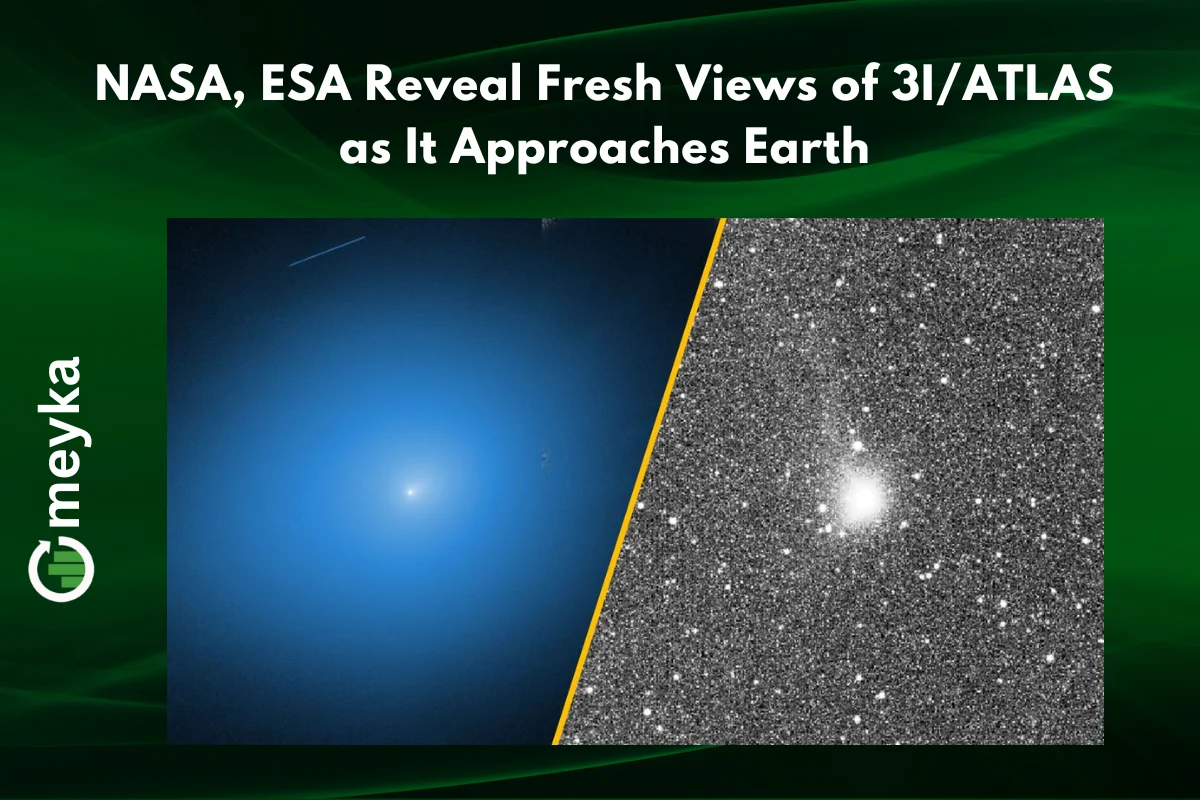
NASA, ESA Reveal Fresh Views of 3I/ATLAS as It Approaches Earth
The interstellar visitor 3I/ATLAS has captured worldwide attention as new images from NASA and European Space Agency (ESA) show it becoming increasingly active on its way through our solar system. As 3I/ATLAS draws nearer, scientists and sky‑watchers alike are calling this one of the most important comet observations in decades, offering a rare peek into material from another star system.
What is 3I/ATLAS?
3I/ATLAS is only the third confirmed interstellar object ever observed passing through our solar system. It was discovered on July 1, 2025, by the ATLAS survey telescope in Chile. The name breaks down as follows: “3” = third such object, “I” = interstellar, “ATLAS” = the survey that discovered it
Scientists estimate the nucleus of 3I/ATLAS to be between 440 meters and up to 5.6 kilometers in diameter, large enough to contain significant amounts of ice, dust, and possibly complex chemicals. It travels on a hyperbolic trajectory, meaning it is not captured by the Sun’s gravity; it is simply passing through. Its speed and path mark it as an object from outside our solar system.
What New Images Reveal: Activity, Brightening, and Structure
New images released by NASA and ESA show that 3I/ATLAS is getting active as it moves away from the Sun, creating a coma of gas and dust, and hinting at a faint tail and jets of material.
High‑resolution data from the Hubble Space Telescope captured on November 30, 2025, show subtle jets and a faint tail structure, signs that volatiles inside the comet are sublimating (turning from ice to gas) under solar heating.
Meanwhile, ESA’s space missions, including a deep‑space probe that happened to be nearby, captured images showing 3I/ATLAS’s dust tail and plasma tail, offering views unavailable from Earth today. Astronomers note that the comet is brightening and changing its color over time, likely because as more ice sublimates, the coma becomes richer in fine icy grains, scattering sunlight differently.
These new photos and data give scientists a unique chance to study material from beyond our solar system, a chance that comes once in many decades.
Why 3I/ATLAS Matters to Science and Humanity
A Glimpse Into Another Star System
Because 3I/ATLAS originates outside our solar system, its composition may reflect conditions in another star system entirely, possibly billions of years ago. Studying its gas, dust, and ice can offer clues about how planetary systems elsewhere formed, and whether the building blocks of life or complex chemistry are common across the galaxy.
Chemistry and Pre‑Solar System Material
Initial observations found that 3I/ATLAS is rich in ices such as carbon dioxide and water, along with dust and possibly metals, materials that are key in planet formation and organic chemistry.
By comparing its makeup to comets from our solar system, scientists may learn whether there is a universal recipe for comets, or whether interstellar objects come with surprising differences.
Rare Opportunity for Observation
Interstellar objects are incredibly rare. Before 3I/ATLAS, we had only two: ʻOumuamua and 2I/Borisov, making 3I/ATLAS a once‑in‑a‑generation event for astronomers to gather data, test theories, and improve our understanding of the cosmos.
Will 3I/ATLAS Reach Earth — Is It Dangerous?
No. Scientists emphasize that 3I/ATLAS will not come close to Earth. Its closest approach is predicted to be around 1.8 astronomical units, about 170 million miles (270 million km) from Earth on December 19, 2025. That puts it still well outside Earth’s orbit, and it poses no threat to our planet.
Because of its distance and faintness, its brightness is not high enough to be seen with the naked eye; 3I/ATLAS will likely remain visible only through telescopes or astrophotography gear, not by casual stargazers.
What’s Next — What Scientists Are Watching
- Observatories worldwide, ground‑based and space‑based, will continue to track 3I/ATLAS into early 2026. Its coma, tail, and brightness may evolve further, revealing more about its composition and structure.
- ESA’s deep‑space missions that observed the comet near Mars or from other vantage points will send back more data, likely revealing its plasma tail, dust distribution, and chemical signatures, invaluable for deep‑space science.
- Scientists hope to analyze the coma’s gases and dust for organic molecules, water content, metals and other elements that may show whether 3I/ATLAS carries building blocks for life, offering insight into whether chemistry similar to ours exists elsewhere in the galaxy.
Even as 3I/ATLAS speeds away into interstellar space, the data collected during its visit may reshape our understanding of how common interstellar visitors are, and how similar their compositions are to comets born in our own solar system.
Conclusion
The fresh revelations from NASA and ESA about 3I/ATLAS are nothing short of extraordinary. This interstellar visitor gives humanity a rare chance to study matter from another star system, icy, dusty, and carrying chemicals that might reflect ancient cosmic processes far older than Earth itself.
3I/ATLAS could teach us about comet formation across the galaxy, the chemical ingredients of planets, and the diversity of materials drifting between stars. Although it does not pose a threat to Earth, its passage offers a unique window into the wider universe.
As scientists continue to observe, analyze, and share data, we may soon learn whether 3I/ATLAS is a typical comet from another star system, or a completely unusual object carrying secrets from the deep past. Either way, it reinforces that our solar system is not isolated; it is part of a dynamic, interconnected cosmic neighborhood.
FAQs
3I/ATLAS travels on a hyperbolic trajectory and at very high speed, which shows it comes from outside our solar system. This makes it the third known interstellar object to reach our neighborhood. Unlike local comets, it may carry different chemical compositions and ice/dust mixtures that formed around another star.
Most likely no, because the comet’s brightness remains faint, it won’t reach naked‑eye visibility. It’s best viewed with medium or large telescopes or through astrophotography, especially when its coma and tail are most active.
No, 3I/ATLAS will pass Earth at least 170 million miles away. That is far beyond any collision risk, and scientists have confirmed it poses no threat to our planet.
Disclaimer:
The content shared by Meyka AI PTY LTD is solely for research and informational purposes. Meyka is not a financial advisory service, and the information provided should not be considered investment or trading advice.