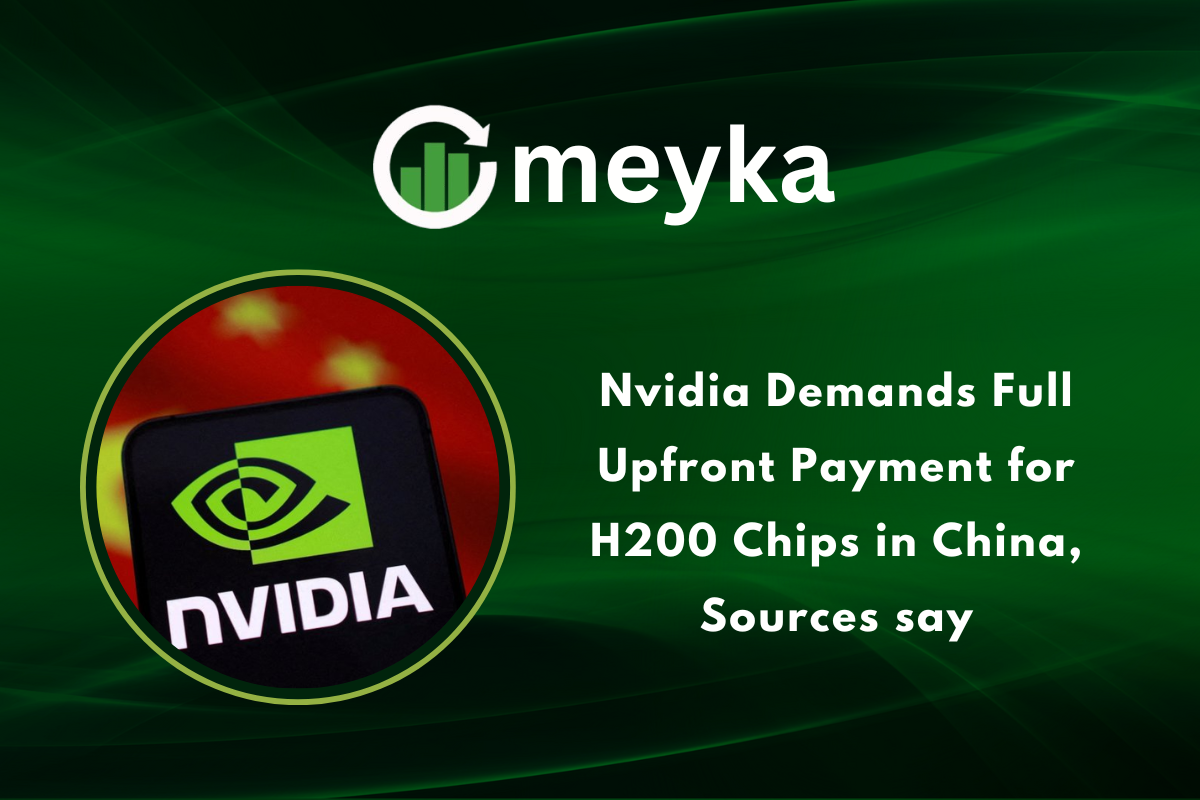
Nvidia Demands Full Upfront Payment for H200 Chips in China, Sources Say
Nvidia has reportedly begun asking Chinese customers to pay the full amount up front for its advanced H200 AI chips, according to multiple industry sources. This move has caught the attention of global investors, chip buyers, and policymakers because it reflects rising uncertainty around supply chains, geopolitics, and payment risks in the high-demand AI hardware market.
The development was first reported by Reuters and later confirmed by several tech and market-focused platforms. It comes at a time when Nvidia remains at the center of the global artificial intelligence boom, with demand for its data center chips far outpacing supply.
Why is this news important?
Payment terms often reveal how confident a company feels about risk, regulation, and customer reliability. In this case, Nvidia’s decision signals a cautious but strategic shift.
Nvidia Tightens Payment Terms for China-Based AI Chip Sales
According to sources cited by Reuters, Nvidia now requires full upfront payment from Chinese clients ordering its H200 AI accelerators. Earlier, many customers were allowed partial advance payments or staggered settlement terms.
This change applies specifically to China-based buyers and not to customers in other regions.
So why is Nvidia doing this now?
The answer lies in a mix of export controls, policy uncertainty, and rising financial exposure. The United States continues to restrict advanced chip exports to China, creating uncertainty over delivery timelines and approvals. By asking for full payment upfront, Nvidia reduces the risk of delayed payments or order cancellations.
Reuters noted that this policy helps Nvidia protect revenue recognition and cash flow, especially when regulatory conditions can change quickly.
Why Nvidia Is Asking for Full Payment Upfront
Nvidia’s move is not sudden. It reflects careful planning in response to fast-changing global rules.
Here are the main reasons behind the decision.
Export control uncertainty
The US government has tightened restrictions on advanced AI chips shipped to China. While the H200 is designed to comply with existing rules, future policy changes remain possible. If approvals are delayed or blocked, Nvidia could face financial exposure.
Upfront payment shifts this risk away from Nvidia.
Strong global demand for AI chips
Nvidia’s data center chips are in extremely high demand worldwide. With limited supply, Nvidia can set stricter terms without hurting sales volume.
Simply put, customers still want the chips even with tougher conditions.
Cash flow and balance sheet strength
Receiving full payment before delivery improves cash flow visibility. For investors, this is often seen as a positive sign, especially during uncertain periods.
A post from Investing.com highlighted that upfront payments reduce Nvidia’s working capital risk in restricted markets.
How Chinese Customers Are Reacting
Chinese tech firms rely heavily on Nvidia chips for data centers, cloud computing, and AI model training. The H200 is especially important because it offers higher memory bandwidth and efficiency compared to older models. However, paying the full amount upfront can strain budgets.
Some buyers are reportedly reassessing order sizes, while others are moving ahead due to limited alternatives. Domestic chip makers in China still lag behind Nvidia in performance, especially for large-scale AI training.
Axi Official shared that while the payment terms are stricter, demand remains strong because Nvidia has few real competitors at this level.
Nvidia and the Strategic Importance of the H200 Chip
The H200 is one of Nvidia’s most advanced AI-focused chips. It is designed for high-performance computing, large language models, and complex AI workloads.
Compared to the H100, the H200 offers higher memory capacity and better data handling, making it ideal for generative AI and enterprise-scale applications.
This explains why Chinese firms are still willing to accept stricter payment terms.
Why not switch to other suppliers?
Alternatives exist, but none currently match Nvidia’s ecosystem, software support, and proven performance. CUDA, Nvidia’s software platform, remains deeply embedded in AI development workflows.
Milk Road AI noted that Nvidia’s dominance gives it pricing and contract power even in restricted markets.
Impact on Nvidia Revenue and Earnings Outlook
From an investor’s perspective, this move could have mixed effects.
On the one hand, stricter payment terms may slightly slow new orders from smaller Chinese firms. On the other hand, upfront payments improve revenue certainty and reduce credit risk.
Analysts expect Nvidia’s data center revenue to remain strong in 2026, driven by global AI spending. Some forecasts suggest that AI-related revenue could account for more than 80 percent of Nvidia’s total sales in the coming years.
This kind of visibility is important for anyone doing AI Stock research, as payment discipline often reflects long-term earnings quality.
Nvidia, China, and the Broader Geopolitical Picture
How geopolitics shape chip trade
The semiconductor industry now sits at the center of global politics. U.S.-China tensions have reshaped supply chains, licensing rules, and trade relationships.
Nvidia has worked to design China-compliant chips, but uncertainty remains.
Aramondiaz posted that upfront payments are becoming more common in sensitive trade corridors due to policy risk.
Does this mean Nvidia is exiting China?
No. Nvidia is not leaving the Chinese market. Instead, it is adapting its business model to reduce risk.
China remains a major market for AI infrastructure. Nvidia continues to engage with regulators and customers to maintain access where possible.
Key Market Implications for Investors
Short-term market reaction
Markets reacted calmly to the news. Nvidia shares showed limited volatility, suggesting investors see the move as risk management rather than a demand warning.
Long-term confidence
For long-term holders, this change may actually strengthen confidence. Strong companies can demand upfront payment when their products are essential.
This is often viewed positively in AI stock analysis, as it highlights pricing power and demand strength.
What This Means for the Global AI Chip Market
Nvidia’s decision could influence other chipmakers. If geopolitical risk remains high, more suppliers may demand stricter payment terms in sensitive regions.
This could reshape how AI infrastructure projects are financed, especially in emerging markets.
Smaller firms may face higher upfront costs, while large tech giants with strong balance sheets will continue to dominate access to top-tier hardware.
Final Thoughts on Nvidia’s Upfront Payment Demand
Nvidia’s decision to demand full upfront payment for H200 chips in China reflects a careful balance between opportunity and risk. The company continues to benefit from unmatched demand for its AI hardware, while protecting itself from regulatory and payment uncertainty.
For investors, this move highlights Nvidia’s strong negotiating position and disciplined financial management. It also shows how geopolitics is reshaping even the most advanced corners of the tech industry.
As AI investment continues to grow worldwide, Nvidia remains a central player. Its ability to adapt to changing rules while maintaining demand will be closely watched by markets in the months ahead.
FAQ’S
Because regulatory uncertainty is higher in China due to export controls.
Possibly at the margin, but core demand remains strong.
Most analysts say no. It reduces risk and improves cash flow quality.
Not significantly in the short term, but it may support premium valuation by lowering financial risk.
Disclaimer
The content shared by Meyka AI PTY LTD is solely for research and informational purposes. Meyka is not a financial advisory service, and the information provided should not be considered investment or trading advice.