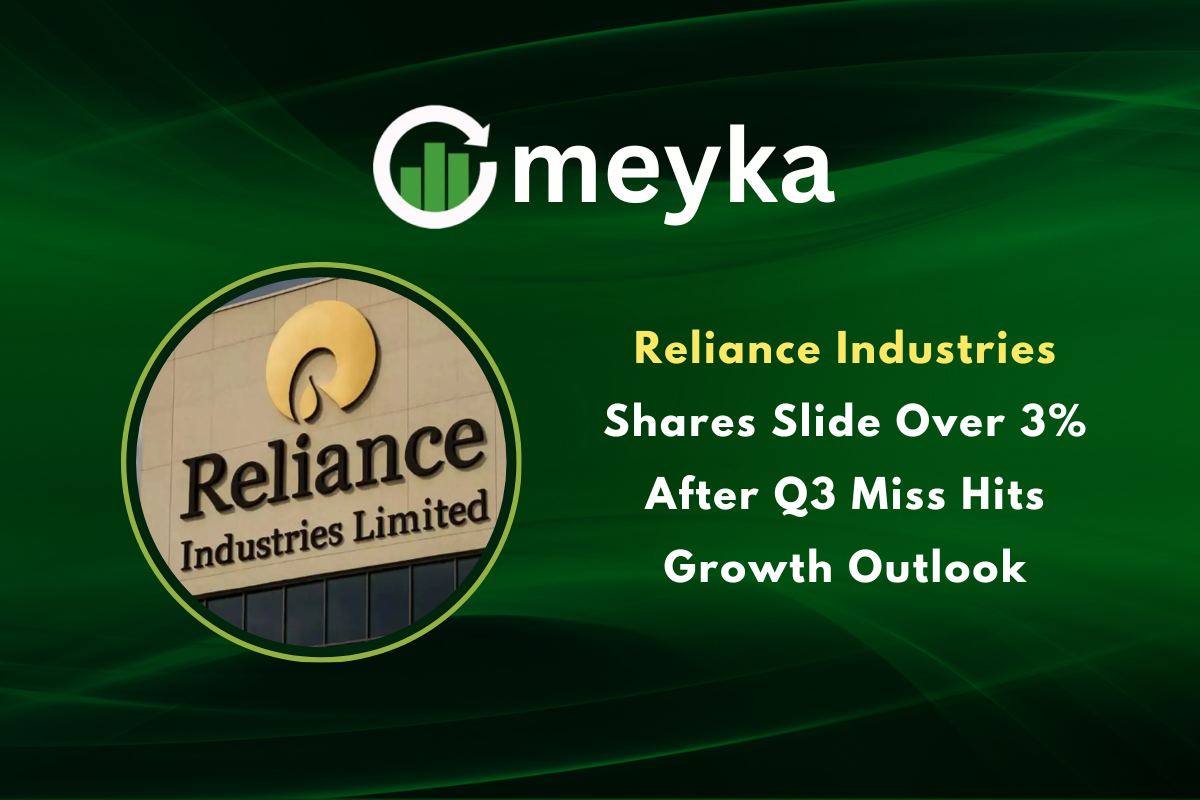
Reliance Industries Shares

Reliance Industries Shares Slide Over 3% After Q3 Miss Hits Growth Outlook

Reliance Industries ‘ shares came under strong selling pressure after the company reported a weaker than expected Q3 performance, raising concerns about its near term growth outlook. The stock slipped over 3 percent, touching a three-month low, as investors reacted to softer earnings across key business segments.

Reliance Industries Limited is a heavyweight in the Indian market. Any negative surprise from the company often sends ripples across the broader indices. This time was no different. The decline reflected investor worries around refining margins, petrochemical demand, and slower growth momentum in some consumer-facing businesses.

This article explains what went wrong, what the numbers say, how experts are reading the situation, and whether the recent fall in Reliance Industries Shares changes the long-term investment story.

What triggered the fall in Reliance Industries Shares?

The immediate trigger was a Q3 earnings miss compared to street expectations. While revenue remained stable, profitability came under pressure, mainly due to weaker refining margins and muted performance in the oil-to-chemicals business.

According to reports from Economic Times and Business Standard, consolidated net profit fell short of analyst estimates. This led to a reassessment of near term growth assumptions.

Investors were also cautious about management commentary, which hinted at a moderate outlook for the coming quarters, rather than a strong acceleration.

This reaction was summed up well in a market update shared by CNBC Bajar on X.

Why do Q3 results matter so much for Reliance?

Q3 is often seen as a key quarter for Reliance Industries. It captures festive season demand for retail, telecom usage trends, and refining margin performance during a volatile global energy period.

When expectations are high and results disappoint, even slightly, the stock reacts sharply.

In simple words, the market was expecting more clarity and stronger momentum signals. What it got instead was mixed performance and cautious guidance.

Reliance Industries Shares Q3 performance explained

• Consolidated profit missed analyst estimates
• Oil to chemicals segment saw margin pressure
• Retail growth slowed compared to previous quarters
• Telecom remained stable but did not surprise
• Management tone remained cautious on near term growth

Segment-wise breakdown of the Q3 results

Understanding the segment-level performance is key to judging the outlook of Reliance Industries Shares.

Oil to Chemicals business:

This segment faced the biggest challenge. Global refining margins cooled from earlier highs. Petrochemical demand remained soft due to global economic uncertainty. This reduced overall profitability.

Retail business:

Retail continued to grow, but at a slower pace. Store expansion continued, yet margins were under pressure due to higher costs and competitive pricing.

Telecom Jio:

Jio delivered a stable performance with steady subscriber growth. However, there were no major tariff hikes during the quarter, which limited revenue upside.

New energy and digital initiatives:

These remain long-term growth drivers, but their financial impact is still gradual.

The Hindu also highlighted these mixed signals in its coverage.

Why did investors react so strongly?

Markets move not just on results, but on expectations versus reality.

Before the results, Reliance Industries shares had already priced in optimism around consumer demand recovery and margin improvement. When Q3 numbers did not fully support that narrative, investors adjusted positions.

Ritik Tanwar pointed out in his analysis that the stock reaction was more about growth outlook than current quarter numbers.

This shows that sentiment shifted from aggressive optimism to cautious realism.

Key concerns impacting Reliance Industries Shares

• Cooling global refining margins
• Slower petrochemical demand recovery
• Competitive pressure in retail
• Limited near-term triggers for sharp upside
• Broader market volatility

Is this a short-term issue or a long-term problem?

This is the most important question investors are asking.

The current pressure on Reliance Industries Shares appears to be short to medium term, not structural. The company still has strong balance sheet strength, diversified revenue streams, and leadership positions across sectors.

However, near-term growth may remain uneven.

Analysts tracking the stock believe that earnings growth could stay moderate over the next two quarters, with improvement expected later as margins stabilize and consumption picks up.

What do valuation metrics suggest now?

After the recent fall, Reliance Industries’ shares are trading closer to their historical average valuation levels.

This makes the stock less expensive than it was before the results, but not deeply undervalued.

Valuation comfort will improve further if earnings visibility strengthens in the upcoming quarters.

Some investors are now using AI Stock research platforms to compare Reliance valuations against global energy and retail peers, aiming to spot long term value zones.

How are institutional investors reacting?

There is no sign of panic selling from large institutions. Data suggests that while some short-term funds trimmed exposure, long-only funds remain invested.

This indicates confidence in the long term business model, despite near term earnings pressure.

For investors using advanced trading tools, delivery volume data shows healthy participation even on down days, suggesting accumulation at lower levels.

What about future growth drivers?

Reliance Industries still has several long-term growth levers.

The company continues to invest heavily in renewable energy, green hydrogen, and digital infrastructure. These projects are expected to scale meaningfully over the next few years.

Retail and telecom remain structurally strong in India’s consumption story, even if quarterly growth fluctuates.

Investors applying AI stock analysis models often factor in these long-duration opportunities when evaluating downside risk.

Should retail investors worry about this fall?

For short-term traders, volatility could continue. The stock may remain range-bound until clearer earnings momentum emerges.

For long-term investors, this fall does not change the core investment thesis, but it does call for patience.

Selling in panic after results-driven corrections often leads to regret, especially in fundamentally strong companies.

Analyst outlook and predicted levels

Brokerages have turned slightly cautious in the near term, with some trimming target prices marginally.

However, most still maintain positive long-term ratings, citing diversified business exposure and strong execution capability.

Predicted price movement suggests consolidation in the coming months, followed by gradual recovery as margins improve.

Educational insight for investors

For a deeper explanation of the Q3 numbers and market reaction, this YouTube analysis breaks down the results in simple language.

Such content helps investors separate emotion from data.

Final verdict for investors

The fall in Reliance Industries Shares after Q3 results reflects tempered expectations, not a broken business.

Short-term headwinds are real. Growth may remain uneven. Yet the company’s long-term vision, balance sheet strength, and market leadership remain intact.

For traders, caution is advised. For long-term investors, patience is key.

As always, investment decisions should align with personal risk tolerance and time horizon.

Reliance Industries has faced cycles before. History shows that quality businesses often reward those who stay calm during temporary setbacks.

FAQ’S

Why did Reliance Industries Shares fall despite stable revenue?

Because profits and future growth outlook mattered more than topline stability.

Is the stock at a three-month low a buying opportunity?

It depends on the time horizon. Long-term investors may consider gradual accumulation.

Will refining margins recover?

Margins are cyclical. Recovery depends on the global demand and supply balance.

Is retail growth slowing permanently?

No, growth is moderating, not reversing.

Disclaimer

The content shared by Meyka AI PTY LTD is solely for research and informational purposes.  Meyka is not a financial advisory service, and the information provided should not be considered investment or trading advice.

Similar Posts

Leave a Reply

Your email address will not be published. Required fields are marked *