US Economy 2026: Consumer Spending Amid a K-Shaped Recovery
As 2026 gets underway, the US economy is at an unusual stage. On the surface, growth looks solid, with GDP increasing at a 4.3% annual rate in late 2025, marking the fastest expansion in two years. Consumer spending has been a key driver. Yet, beneath these figures lies a critical question: Is this growth benefiting everyone? The concept of a K-Shaped Economy explains the divide, where some Americans and industries prosper while others lag. In 2026, consumer spending trends will show how this unequal recovery is affecting the everyday lives of various income groups.
Understanding the K-Shaped Recovery
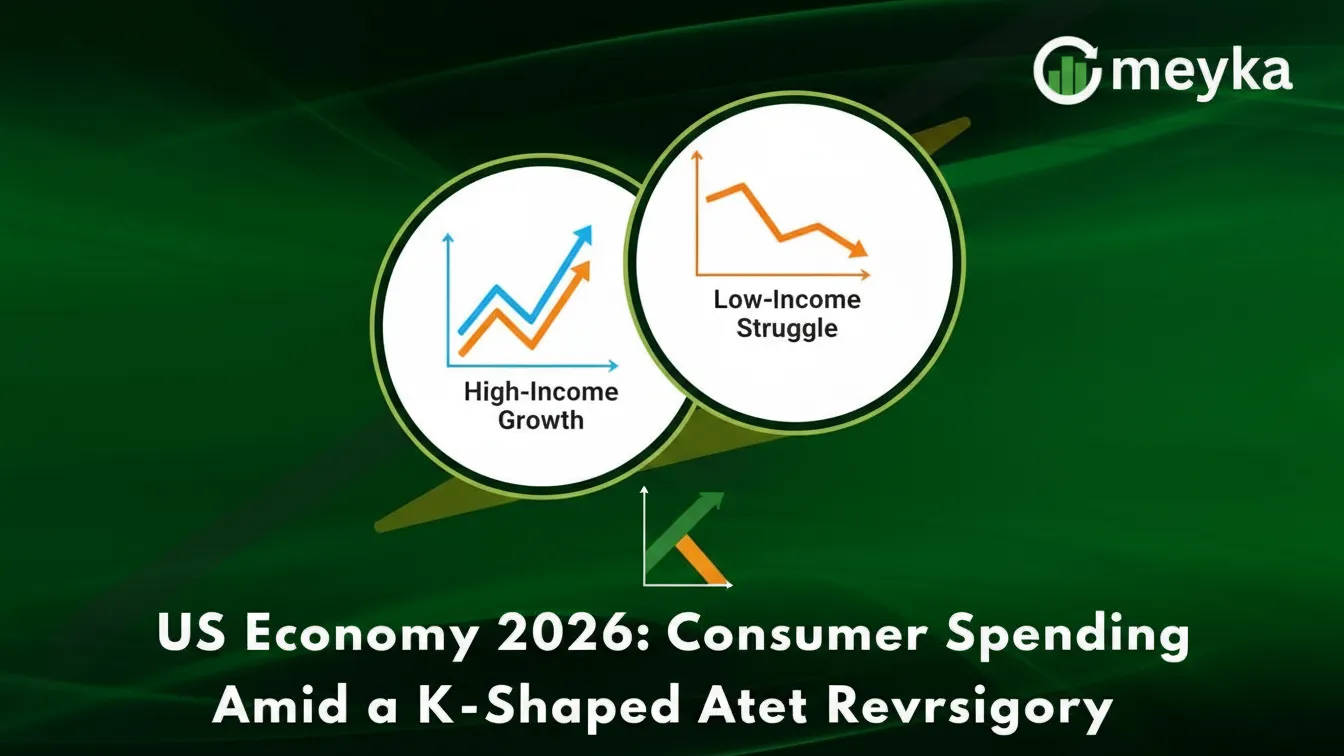
- A K-shaped recovery occurs when some sectors and households grow quickly while others fall behind. The âKâ shape illustrates one branch rising (thriving sectors and people) and the other falling (struggling sectors and households).
- High earners: Wealthy households and leading tech companies report strong profits and increasing asset values.
- Lower-income households: Many are cutting back and focusing spending mainly on essentials.
- Sector winners: Technology, AI services, and luxury goods continue to expand rapidly.
- Sector laggards: Budget retail, travel, and low-cost services grow slowly or decline.
- Spending patterns: High-income groups drive discretionary purchases, while lower-income households prioritize necessities.
- GDP perception: Overall GDP growth may mask the uneven benefits across income groups and industries.
Consumer Spending Trends in 2026
- Overall spending: Consumer spending accounts for roughly two-thirds of US GDP, making it a key measure of economic health.
- High-income households: The top third of earners boosted spending about 4%, focusing on luxury goods, travel, tech, and services, supported by their investments.
- Middle-income households: More cautious with budgets, many delay major purchases like cars or home upgrades while managing bills and debt.
- Lower-income households: Their spending has grown only slightly, just over 1%, primarily on necessities like groceries and utilities, which restricts their impact on broader economic growth.
- Key insight: While GDP shows growth, spending experiences differ widely across income groups.
Factors Driving Divergent Spending Patterns
- Income inequality & wealth distribution: Wealthy households benefit from stock market gains and higher property values, whereas lower-income families experience minimal improvement.
- Inflation & cost of living: In 2025, prices rose faster than wages, straining middle- and lower-income households, particularly for basic necessities.
- Credit & savings: Higher-income consumers have more savings and credit access, while lower-income groups rely on credit cards, risking long-term strain.
- Policy & tax changes: Measures such as increased tax refunds in 2026 may boost spending, but the effects are uneven across income levels.
Sectoral Impacts and Opportunities
- Retail & consumer goods: The market shows a clear divide. Premium brands and off-price/value retailers are seeing strong sales, while mid-tier stores lag.
- Travel & hospitality: Wealthier consumers spend more on travel and experiences; budget travel and hospitality recover slowly.
- Tech & AI investments: Robust capital spending and increased AI adoption are fueling growth in digital services and data center sectors.
- Housing market: High-income households drive demand for luxury and city properties, while many buyers still face affordability challenges.
- Business insight: Companies serving affluent and tech-savvy consumers are growing; mass-market and value-focused businesses face stiffer competition.
Economic Implications of Divergent Consumer Spending
- GDP & growth stability: Consumer spending supports GDP, but most growth comes from high-income households. A slowdown in their spending could weaken overall growth.
- Employment & wages: Job growth is strong in luxury services and tech, while retail and hospitality, which employ many middle- and lower-income workers, continue to struggle.
- Inequality & social impact: Persistent income inequality can limit overall demand, slowing business growth if lower-income consumers cannot afford essentials.
- Risk of fragility: Economists warn that the economy may be vulnerable beneath headline numbers. Stock market or credit downturns could quickly reduce high-income spending.
Conclusion
The US economy in 2026 is a picture of both power and weakness. While consumer spending is still the main reason for the growth, the income groups do not equally share the benefits. The K-Shaped Economy is not merely a theory; it has a real impact on the everyday existence of a huge number of people in the US. The data we provide indicates that for growth to be real and for the economic cycle to be continuous, the governments and the firms need to work in the area of inclusive strategies that will allow for wage gains, price stabilization, and so on, for all households and not just the rich ones. In the end, the US economy is going to be strong only if the recovery is shared with more families.
FAQS
A K-Shaped Economy occurs when some sectors and income groups grow rapidly while others lag, creating an uneven recovery.
High-income households lead spending, focusing on luxury goods, travel, tech, and services, while middle- and lower-income households spend cautiously.
Technology, AI, and luxury sectors are booming, whereas discount retail, travel, and budget services recover more slowly.
Unequal growth can slow overall GDP if high-income spending declines, reduce employment in lagging sectors, and worsen social inequality.
Disclaimer:
The content shared by Meyka AI PTY LTD is solely for research and informational purposes. Meyka is not a financial advisory service, and the information provided should not be considered investment or trading advice.