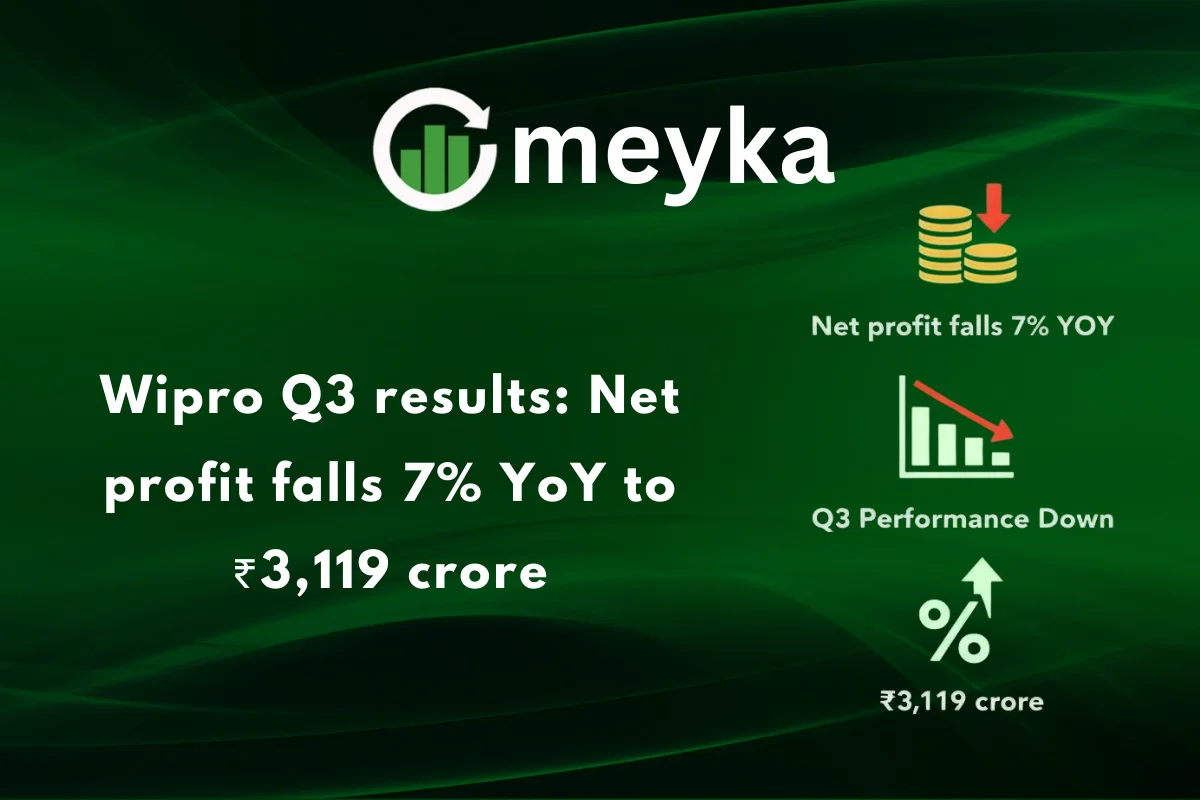
Wipro Q3 Results: Net Profit Falls 7% YoY to ₹3,119 Crore
Wipro, one of India’s major IT services companies, reported mixed third‑quarter results for fiscal year 2026, with its net profit falling 7% year‑on‑year to ₹3,119 crore, even as revenue continued to grow modestly from its core operations. This performance came as many industry peers also faced profit pressures partly due to new labour code implementation and changing demand patterns in the global technology landscape.
The quarterly update highlights both strengths and weaknesses in the business, offers insights into how evolving market forces are affecting stock market performance, and gives investors and analysts material to guide stock research decisions.
Overview: What the Numbers Show
For the quarter ending December 31, 2025 (Q3 FY26), Wipro posted consolidated net profit of ₹3,119 crore, which was about 7% lower than the ₹3,353.8 crore it reported in the same period last year.
Meanwhile, the firm’s revenue from operations rose about 5.5% year‑on‑year to ₹23,555.8 crore, indicating continued demand for its services across global markets.
On a sequential basis revenue improved roughly 3.8% from the previous quarter, reflecting that while profit was under pressure, topline growth remained intact.
Wipro’s board also declared an interim dividend of ₹6 per share, showing management’s intention to maintain shareholder returns despite profit headwinds.
Why Net Profit Declined
The fall in profit came even as revenue grew, and analysts point to several factors behind this trend:
1. Impact of New Labour Codes
One of the main reasons cited for the dip in net income was the effect of India’s new labour codes, which introduced one‑time charges and increased recurring employee costs for IT firms operating in the country. These changes impacted operating margins and overall profitability for Wipro and several of its peers.
Industry experts noted that quarterly earnings across the Indian IT sector showed unusual expense recognition due to these regulatory shifts, which may not fully reflect underlying business performance.
2. Margin Compression
While Wipro’s revenue expanded, its operating margins faced pressure. According to detailed results, operating income and EBIT (earnings before interest and taxes) were lower than street expectations, and margin contraction was visible compared with prior quarters.
3. Booking Trends
Total deal bookings for the quarter were reported at around $3.3 billion, down modestly year‑on‑year, while large deal bookings were about $0.9 billion. Weakness in bookings sometimes translates into future revenue and margin challenges if not reversed.
Despite these issues, Wipro’s operating cash flows remained strong, suggesting good cash generation even as profitability metrics softened.
Segment and Regional Performance
Wipro’s results reflected differing dynamics across geographies and business segments:
1. IT Services Segment
The core IT services business saw moderate growth, with IT services revenue rising about 1.2% sequentially and a roughly flat year‑on‑year change in constant currency terms. This segment continues to be the main engine of Wipro’s operations.
2. Communications and Enterprise Clients
Particularly in segments like communications and enterprise solutions, demand remained steady and helped support overall revenue growth, even though it was not strong enough to lift net profit.
3. Americas and EMEA Markets
Growth in the Americas, a major market for Indian IT firms, was moderate and similar to trends seen with other Indian IT companies in the same quarter, reflecting cautious enterprise spending patterns in some sectors.
Comparison with IT Sector Peers
Wipro’s results mirrored a broader pattern in the Indian IT industry in Q3 FY26 where revenue growth remained moderate but profitability was affected by regulatory charges and one‑time costs:
- Infosys also reported modest revenue growth with profit impacted by some additional provisioning.
- Tech Mahindra posted a revenue increase and profit rise.
- HCLTech saw revenue grow strongly but profit dipped due to similar industry pressures.
This mixed performance across IT firms underscores that while demand for digital and enterprise technology solutions continues, external factors like cost pressures and regulatory adjustments weigh on bottom‑line results.
Investor Reaction and Stock Market Sentiment
Following the earnings release, Wipro’s share price experienced volatility as traders digest the implications of lower profit despite revenue growth and dividend announcements.
Investors tracking Wipro have balanced optimism about long‑term service demand with caution about near‑term profitability and margin recovery. Many market participants emphasize that while the stock may be undervalued in some technical models, it also needs clear evidence of margin expansion before broader gains can be sustained.
In stock research updates, analysts highlighted that although the quarter showed resilience in revenue, profit contraction and cost pressures could weigh on valuations unless future quarters demonstrate margin recovery and stronger deal bookings.
What Analysts Are Watching Next
Financial analysts are closely monitoring several metrics to gauge Wipro’s future performance:
- Revenue and Margin Trends: Future quarters will reveal whether Wipro can grow revenue faster than operating costs, especially in the changing regulatory environment.
- Deal Bookings and Pipeline Strength: Large deal wins and the strength of the sales pipeline will be critical indicators of future topline momentum.
- AI‑Driven Services Growth: Wipro’s investment in AI‑enabled solutions and platforms is seen as a key differentiator. Analysts track how much of revenue and new deal wins come from AI‑related projects as these often carry higher margins and recurring components.
- Global Market Demand: Demand from major markets like the U.S. and Europe, especially in sectors such as banking, financial services, insurance, and communications, will shape Wipro’s growth path. Continued strength in these regions can offset slower parts of the business.
Balancing Short‑Term Pressures with Long‑Term Potential
Despite a year‑on‑year decline in net profit, there are reasons investors maintain a long‑term view for Wipro. A growing global need for digital transformation, cloud integration, cybersecurity, and AI‑enabled business solutions creates ongoing opportunities for large IT service firms.
Wipro has emphasised its focus on innovation and expanding service offerings in emerging tech areas, which could help it capture larger market share and improve future results if execution remains strong.
FAQs
Wipro’s net profit fell about 7% YoY due to higher operating costs linked to new labour code implementation, margin contraction, and one‑time charges that affected profitability even as revenue grew.
Yes, Wipro’s revenue from operations rose by around 5.5% YoY to ₹23,555.8 crore, showing continued demand for its services.
Investors should watch future margins, deal bookings, and growth in strategic services such as AI‑led solutions to assess longer‑term value and growth prospects.
Disclaimer:
The content shared by Meyka AI PTY LTD is solely for research and informational purposes. Meyka is not a financial advisory service, and the information provided should not be considered investment or trading advice.