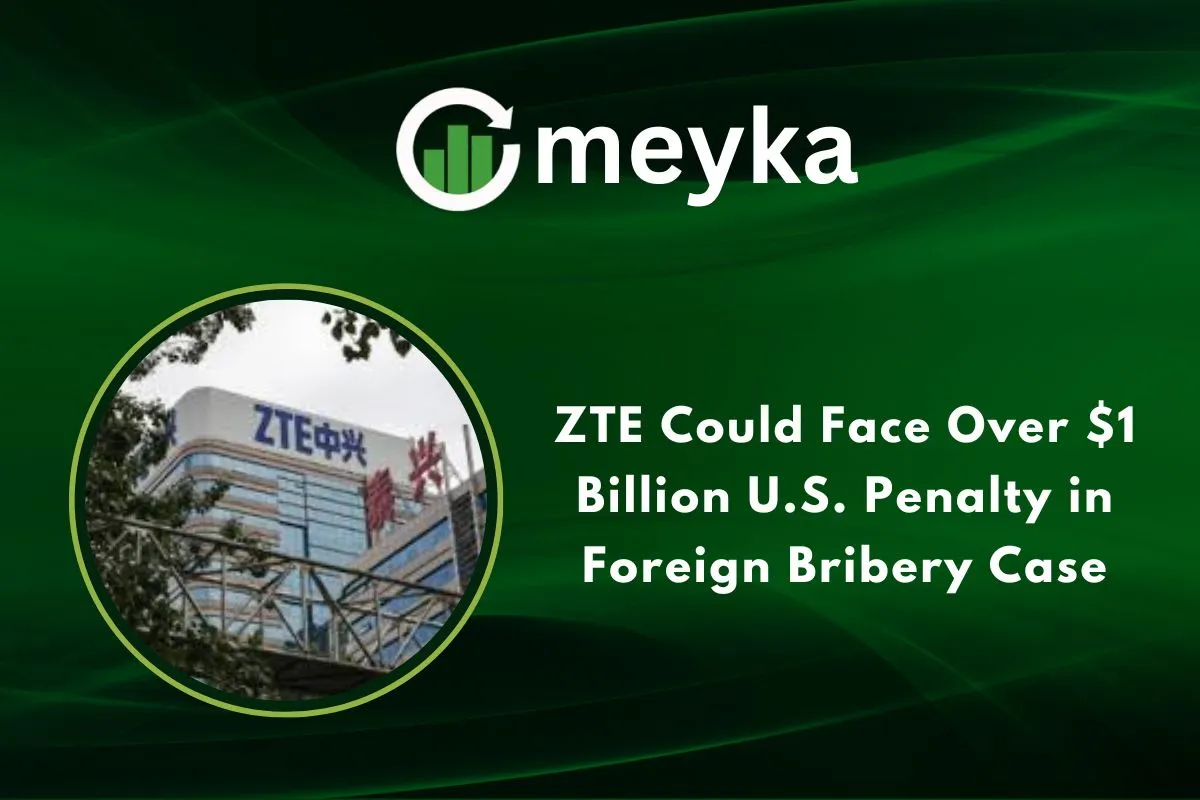
ZTE Could Face Over $1 Billion U.S. Penalty in Foreign Bribery Case
ZTE Corp, the Chinese telecom‑equipment giant, may soon be hit with a massive penalty from the U.S. government. According to recent reports, the possible fine could exceed US$1 billion under a pending foreign‑bribery investigation by the U.S. Department of Justice (DOJ). This news matters not only to ZTE but to the global tech world, regulators, and governments. If the DOJ follows through, it could reshape how big telecom firms work across borders. We examine the background behind ZTE’s legal troubles, what the new allegations involve, why the penalty might be steep, and what this could mean for ZTE and the telecom industry.
ZTE’s Past With U.S. Regulators
ZTE isn’t new to U.S. scrutiny. In 2017, the company pleaded guilty to illegally exporting U.S.-origin equipment to countries under sanction, including Iran and North Korea. As a result, ZTE agreed to pay a combined penalty of US$1.19 billion, the largest such fine ever imposed at the time for export‑control violations. Under that settlement, ZTE also accepted strict compliance requirements: active audits, monitoring, and restrictions on future U.S. exports if it violated the terms.
Even after that settlement, U.S. regulators flagged ZTE for false statements, saying that the company misled U.S. authorities about disciplining employees involved in the export violations. Due to this history, ZTE was already under probation, subject to compliance scrutiny, and had its export privileges suspended. This past sets a weighty context for the new bribery allegations.
Details of the New Foreign Bribery Case
The DOJ is investigating ZTE for alleged violations of the Foreign Corrupt Practices Act (FCPA). The case centers around suspected bribery in deals that ZTE struck in South America, possibly involving business in Venezuela. The probe reportedly looks at instances from as far back as 2018. In at least one account, U.S. officials described the potential charges as a “criminal conspiracy to commit bribery.” If proven, these allegations would mark a serious breach. It would mean ZTE used bribes or other improper payments to influence foreign officials or win government‑related contracts.
At the moment, ZTE says it is in “ongoing communication” with the DOJ and insists that it maintains a strict anti‑bribery policy. But the uncertainty remains: we do not know exactly which contracts are under scrutiny, how deep the bribery allegations go, or when the DOJ might reach a resolution.
Why the Penalty Could Exceed $1 Billion
Under U.S. law, fines for FCPA violations depend on several factors, including how much money was gained via corrupt deals, how long the misconduct lasted, and whether the firm has prior violations.
In ZTE’s case, the risk of a high penalty is amplified because of:
- Repeat Offender Status: ZTE already paid a huge penalty in 2017 for export‑control violations. That history could lead regulators to push for stricter punishment.
- Scale and Duration: The alleged misconduct spans several years and possibly multiple jurisdictions. That tends to raise the stakes in FCPA cases.
- Overlap With Past Compliance Agreements: ZTE remains under a prior compliance umbrella with U.S. authorities. A bribery finding might not only trigger a new fine, but could also revive export bans or stricter oversight.
Some sources even suggest that, based on illicit profits from corrupt contracts, the final settlement could reach as much as US$2 billion or more. That’s a huge figure. For context, ZTE reported profits of around US$1.16 billion in the preceding year.
Impact on ZTE’s Global Business
If ZTE is forced to pay big and possibly face renewed export restrictions, the fallout could be serious.
- Supply Chain Disruptions: ZTE heavily relies on U.S.-origin chips, software, and components for its phones, routers, and telecom equipment. A renewed export ban could choke crucial supplies.
- Telecom Contracts at Risk: Many overseas telecom deals rely on a stable supply. If ZTE’s operations stall or get blocked, infrastructure projects, especially in developing or emerging markets, could be delayed or canceled.
- Investor Confidence: Already, the news triggered a sharp drop in ZTE’s share price. A large penalty and ongoing uncertainty may further deter investors or partners.
- Global Reputation: ZTE risks being labeled as a “risky” vendor. Governments and companies worldwide might reconsider using ZTE gear, particularly in sensitive infrastructure.
Regulatory and Geopolitical Implications
We must also view this case as part of a broader pattern. The U.S. is increasingly using its laws, like FCPA and export controls, to police global tech firms. ZTE could become a high-profile example. That has a bigger geopolitical weight, especially given ongoing tensions over tech competition, 5G, and supply‑chain security. A harsh outcome for ZTE might discourage similar firms from risky behavior abroad. For China, a heavy penalty or renewed export restrictions may stir regulatory or diplomatic pushback. And for telecom partners globally, it may force a rethink of risk, compliance, and vendor selection.
Compliance Challenges in the Telecom Industry
Why are telecom firms like ZTE vulnerable? Building telecom networks often involves overseas contracts, government deals, and complex procurement processes. Many deals, especially in developing countries, involve public officials or state‑owned entities. That creates a higher risk of bribery or corruption. Add to that cross-border supply chains, dual-use technology (telecom gear that could have security implications), and strict export rules. Mistakes, or misconduct, can be costly. The ZTE case underscores how dangerous non‑compliance can be. It shows that even giants must follow global norms or face huge consequences.
What Happens Next
We don’t know when the DOJ will make a final decision. But several outcomes are possible:
- Deferred Prosecution or Settlement: ZTE may agree to pay a large fine (say, > US$1 billion), plus accept new compliance conditions.
- New Compliance Oversight: If the settlement includes a monitor or stricter audit obligations, ZTE’s business at home and abroad may be constrained.
- Export Restrictions Reinstated: The U.S. could re‑impose export bans, making it hard for ZTE to source chips, software, or other critical components.
- Global Fallout: Telecom clients and partners might distance themselves to avoid reputational or legal risk.
The final verdict could change the landscape for ZTE and for all global telecom players.
Conclusion
The possible $1 billion-plus penalty facing ZTE shows how seriously the U.S. treats foreign bribery and compliance. For ZTE, the stakes are enormous: financial, legal, operational, and reputational. For the global telecom industry, this is a wake-up call. Firms cannot ignore compliance, transparency, and ethical conduct, especially when working across borders. We must watch closely. What happens to ZTE could shape how telecom deals are done worldwide, and how regulators, in the U.S. and beyond, enforce their rules.
FAQS
ZTE is under investigation for alleged bribery of foreign officials. The U.S. may fine the company over $1 billion, marking a serious legal and financial challenge.
The fine could exceed $1 billion because ZTE has past violations, the alleged bribery spans years, and U.S. law punishes repeated or large-scale misconduct heavily.
If fined, ZTE may face export restrictions, supply chain issues, and loss of international contracts. Investor confidence could drop, and global partners might rethink their deals.
The case shows that global telecom firms must follow rules carefully. Any bribery or illegal deals abroad can lead to massive fines and reputational damage.
Disclaimer:
The content shared by Meyka AI PTY LTD is solely for research and informational purposes. Meyka is not a financial advisory service, and the information provided should not be considered investment or trading advice.